
Noa Borstein Hadad
On Saturday, March 28, 2026, the siren sounded in Mitzpe Ramon. This was the only alarm since the start of the last campaign against Iran (as of writing). In the week since then, the city’s 6,000 residents have been joined by another 3,000 vacationers, who fled from the north and center to this desert town.
We arrived on Friday, March 6, in the morning. It was the day of our wedding, which should have taken place, but due to the “situation,” it was postponed – currently indefinitely. So, a friend offered us her holiday home in Mitzpe Ramon, in the Negev Highlands. We were looking forward to a quiet weekend. No sirens, no excitement, and all businesses closed. We planned a stay-in weekend and brought our own food.
Mitzpe Ramon is a unique kind of town. It was founded in 1954 as a road-building camp when the road through the Negev Highlands to Eilat was paved. Later, it became a mining town, then an exclusive experiment in communal living. However, it never actually succeeded until Israel evacuated the Sinai in 1982, following the peace agreement with Egypt. Following the evacuation, Mitzpe became a magnet for the off-road desert guides who had fallen in love with the wide-open spaces and mountains of the Sinai. The Negev is not the Sinai, and desert travel was complicated by the need to share the desert with military training areas. But Mitzpe developed a certain kind of off-road aura, a magnet for the just-returned-from-India crowd and seekers of an alternative lifestyle, alongside a Torah community of religious families. Perched on the cliff overlooking Makhtesh Ramon (The Ramon Crater), it developed its own unique, peaceful, mountain-desert character.
To our surprise, we arrived at a town in a blaze of action. Mitzpe was a non-stop party. On Friday morning, the Spice Routes neighborhood, named after the Nabatean Saudi Arabia-Mediterranean spice routes, a failed industrial park, turned into an ebullient social center. The streets of the neighborhood were filled with young people dancing to trance music—some with painted faces, and a bunch of barefoot kids running about. We watched as we waited for our iced coffee from one of the coffee shops next to a second-hand clothes store and a bakery, patiently waiting in the long coffee queue. No siren shattered the moment.
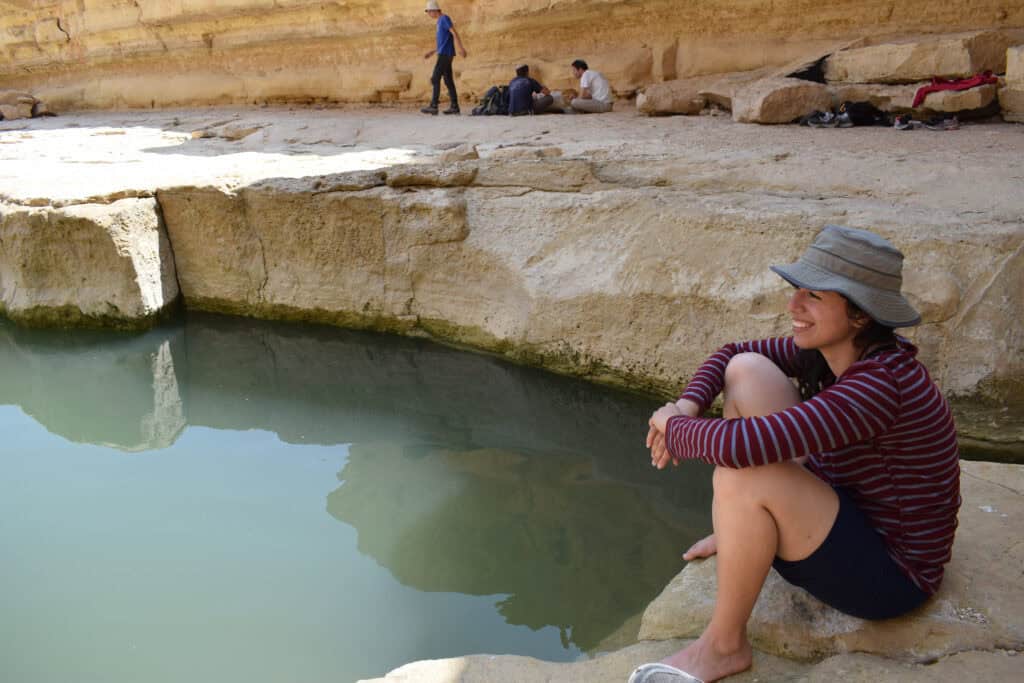
We continued on a trip to the Ein Yelek spring, actually a secluded pot hole that fills with water after rainy years. Around the spring, hidden in a little gulch, a group of young people was sitting around with beers and stories of the after-the-army trip that many of them had just returned from. Ayal, recently returned from a trek in South America, told us that the group had come together in the last few days in the local hostel. “We came here to get away from the war – to a place without sirens”. Each one of the young people, some just back in Israel, others just released from army service, had reached Mitzpe to find a few days of quiet.
“Sit next to us, and I will tell you a story,” says Ravit, a tall, tanned woman in her twenties, while another member of the group attempts to swim in the freezing spring. The group gathers around Ravit, while a sweet-smelling cigarette passes around. Ravit tells us about the beautiful beaches of Capurgana, Colombia, near the border with Panama, from where she had recently returned, straight into a war zone.
The brave guy trying the frozen waters of the spring lets out a shrill scream and exits quickly. The magic story moment of beautiful, faraway beaches is broken, and we pack up, trying to get back to Mitzpe before sunset. Ayal asks for a lift. Along the way, he tells us about his latest Euro-trip, still amazed by open borders and wide spaces, and by countries where security and safety are not fragile.
Camel Hill
Saturday morning, a week into the war, we make our way to Camel Hill, a local observatory overlooking the Maktesh, on a camel-shaped rock on the cliff edge. Religious families on their way to the synagogue dot the empty streets. On the hill, several families with children join us. We share our binoculars with the children for a closer view of the Negev Highlands. In such a small country, at the height of a war, it is difficult to believe that such a peaceful place exists.
At this very moment, our cell phones start vibrating with missile warnings. But nothing breaks the silence. Mitzpe is not on anyone’s map.
Two hours later, I am seated on the porch of my friend’s vacation home. The desert winds carry the sounds of another party and the smells of a barbecue. On the other side of the road, in a construction lot with three unfinished houses, a lively Purim party is in full swing. “This is the meaning of life, dancing between the sirens,” one of the party-goers explains.
That evening at the local “Berekh” pub, a full-scale party is revving up– even though Home Front security regulations currently forbid gatherings of more than fifty people. The police arrived and decided to allow it, despite the regulations, which seem not applicable in Mitzpe. Michal, the waitress, who has been living in Mitzpe for the past two years while saving for circus studies, explains that parties at the pub are a nightly occurrence. “The only difference,” she adds, while clearing our table, “is that this week I don’t know everybody around the table.”
The pub, the only one in the Spice Routes neighborhood, is full. We try to find a place at the bar and settle for a table for two with Gal and Gilad, a young couple from Tel Aviv. Gal used to live in Mitzpe before moving to Tel Aviv. However, with the first siren, she moved back. Gilad joined her.
Gal, a doula by profession, had to return to Tel Aviv to assist a client giving birth. At the height of labor, the mother and the team had to make their way to the hospital shelter. She quickly returned to Mitzpe, to the clean desert air. “We are here without a deadline,” she says. “We will go back when it is safe again.”
Development Town
Mordechai was born and raised in Mitzpe. He is 18 and about to enlist in the Givati Brigade at the end of the month. He is currently hanging out at the pub with his friends. “Mitzpe is a fun place,” he says, “but the only time the town fills up is during a war.”
Actually, there is no place to hang out except the pub. “Why is this the only pub?” we ask. “There are not enough clients to go around for two,” he explains, “and another pub would only start a local war.”
In the last few years, a local war has indeed been fought in Mitzpe, between the religious and secular communities. “The growing religious community, which began settling in Mitzpe a decade ago, landed on a very secular, hippie-like community”, explains Mordechai. “Each community wants the town to have their characteristics – closed or open on the Sabbath, more synagogues instead of secular community centers, and more. Government ministries back the religious communities, and the secular population feels like they are fighting a losing battle. The two communities will have to live with each other,” explains Mordechai, “War is not appropriate for our beloved town”.
Mordechai gets up to dance in the interior room of the pub. The local community meets the Tel Aviv yuppies for a trance party in the desert. We join in and dance until the first light of the morning.
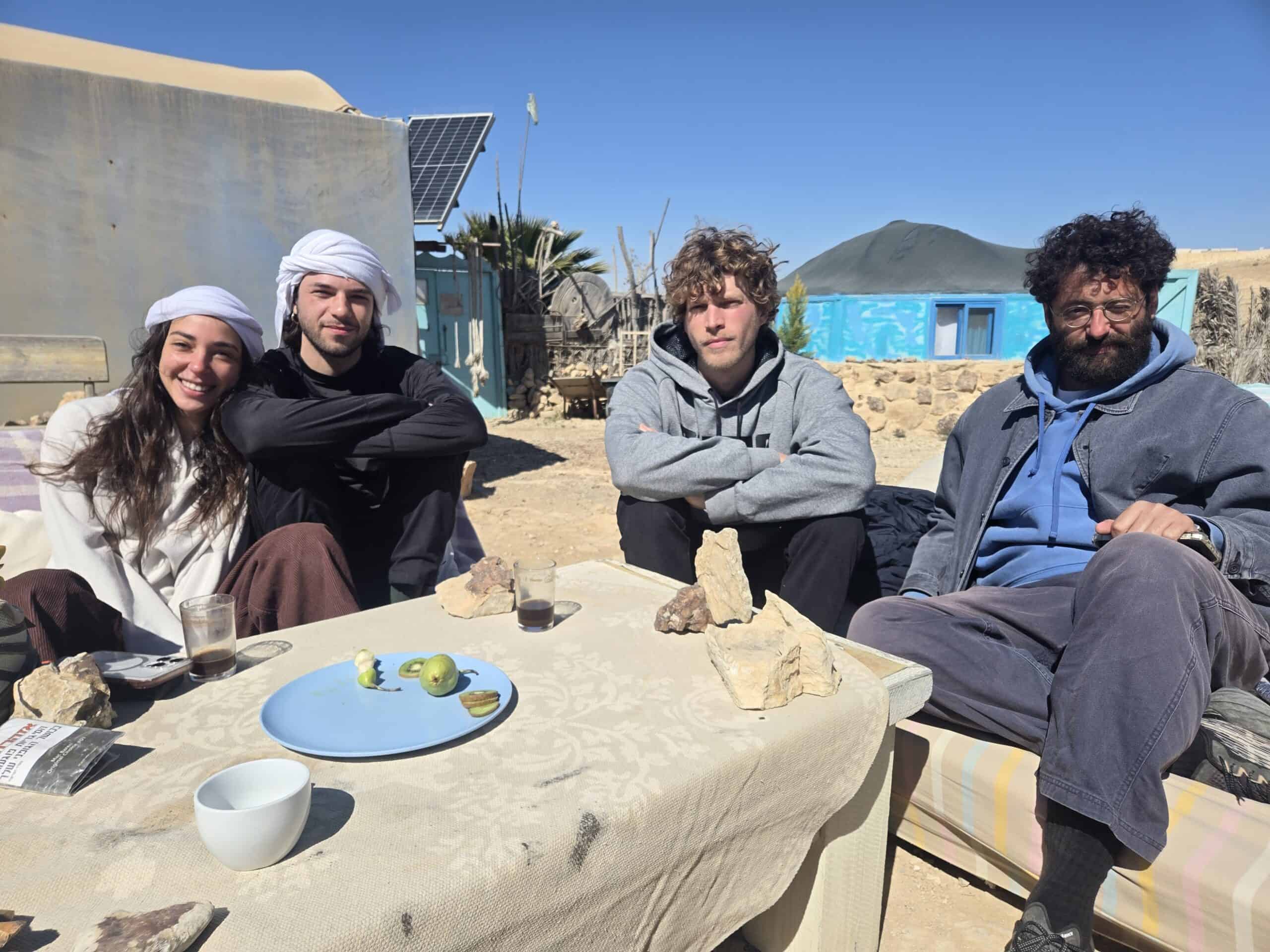
We start the next morning late, very late. The place feels like a vacation, and everyone here is a late starter. Passing through the ecotourism area, we find a local hostel. Cabins with no electricity, public outdoor showers, and a circle of old sofas open to the wind and sun. We meet Taliya Lin Ron, Yarden Tiger, and Nadav Tom Artshik, who made their way to Mitzpe with the first siren. The three are actors who met a film director, Pinhas Viya, in the hostel. They are now considering continuing south, to Eilat or the Sinai.
“We have been here for a week”, explains Taliya, “and it seems that we have had enough of the extreme quiet”—the discussion centers on films and advice on things to do. Very soon, the conversation turns to the events of October 7; for many of this generation, this is the moment that marks the start of their lives.
In the Spice Routes neighborhood, business goes on as usual. The streets are full, and the line for coffee is long. Standing in line at the local pastry shop, we listen to the omgoing conversation. “There was a missile strike in North Tel Aviv”, one woman tells her friend, “someone was hit, badly”. “We have asked to extend our stay here,” the friend adds, “but there is no available place. People are knocking on doors asking if there is a place to stay, with full payment.”
“Mitzpe is a good place for your Chapter Two,” A man in the line adds. “I wonder what Tinder offers here”.
Black desert humour. Starting a new life in the desert. Maybe this will finally bring life to the small desert town perched on its cliff, where the only thing to do is trekking in the desert, enjoying the tranquility.
Noa Borstein Hadad