Seven months ago, on the night of June 15, 2025, at 3 p.m., the floor of the small bomb shelter of my building on Daniel Street in Bat Yam trembled. The light went out at once. A cloud of dust rose and filled the concrete-walled room. And then silence. Louder than the “boom” heard outside the building a moment earlier. The door of the shelter flew open, with a bang, from the blast that glued us all to the wall. Two passersby rushed in. “A missile has hit here, on the building!” they shouted and stormed out of the shelter. Even my first-floor neighbor’s loud transistor fell silent.
Emerging from the shelter, we blinked in disbelief at the extent of the destruction. The missile had hit the tallest building in our neighborhood – right in front of our building – the corner of Jerusalem Street and Daniel Street.
Thirty-five people are missing, news websites reported. Later that week, the final death toll of nine was announced.
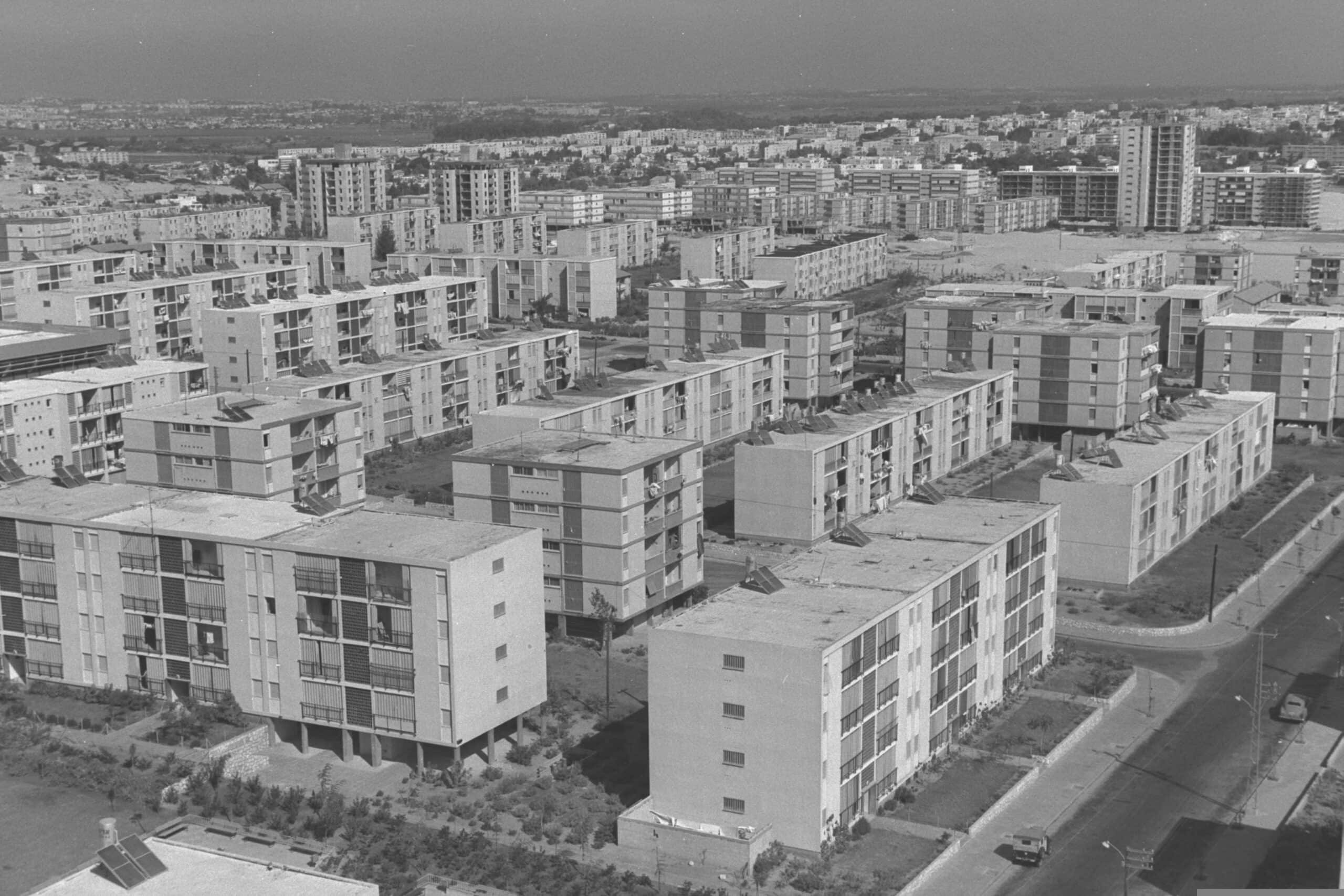
The fleet of rescue vehicles, parked at the intersection of the two streets in the cordoned-off disaster area, encountered a parallel flood of civilians seeking to help or gather information about the situation. For our neighborhood, the building is a local landmark. The first “skyscraper” in the neighborhood, built with communal balconies, a kind of roofed area in the middle of the building, shared by all the neighbors. On the ground level is a commercial center that is almost as old as the entire neighborhood, with an ancient glazier who doesn’t intend to retire, a grocery store that imports nostalgic Russian food products, a store of cleaning products, and more.
“The scene has been declared a disaster area,” declared the news broadcaster. My neighbors, with dusty faces, walk aimlessly through the debris. Shards of glass, broken shutters, squashed vehicles, and unimaginable amounts of dust cover the road and sidewalk. A man empties a half-liter bottle of water on his car, impossibly trying to clear the dust.
A woman in a wheelchair is led by her daughter, who is holding a suitcase in her other hand. A half-torn Israeli flag flutters from a window with nothing left but a frame. In front of the “scene of the disaster,” a man and a woman sit on a bench, chain-smoking, staring at the building that, until a short time ago, was their home.
But all this was so long ago
On the morning of Saturday, February 28, 2026, when we, the residents of the small building on Daniel Street, met again in our shelter, the past was not foremost on our minds. The new neighbor’s dog, who had moved into the building after the explosion and the ensuing renovation, behaved like a Tasmanian Devil. One by one, she attacked all the dogs in the shelter. The 13-year-old boy holding her leash tried to calm her down. “Everything is fine,” he told her. The other dogs sniffed each other. The neighbor on the second floor, with his pet pincer, who was always dressed in the latest doggy style, handed out snacks for all. For the dogs, of course, not for us.
In the corner of the shelter, lit by the new light we had installed after the electricity was completely burned out in the previous round, sat the neighbor with the transistor. He turned the volume up, all the way, and a little more. Meaningless words from news broadcasters filled the air. The upstairs neighbor, with her two adult children, came down with folding chairs and set them up in front of the old bicycles leaning against the wall. Three months ago, regardless of anything, the House Committee (that’s me) decided to move an old sofa to the shelter – it’s better for us to have somewhere to sit instead of throwing it in the trash.
Subdued conversations in Russian, Arabic, and Hebrew resonate in the shelter. The words are absorbed into the white concrete walls. “Why did they start an attack in the winter?” one of the neighbors tries to start a conversation. “They usually attack in the summer,” says another neighbor. “It doesn’t matter if it’s winter or summer; there are elections soon,” another neighbor answers. “What a cynic you are,” the neighbor who started the conversation throws at her. It’s about the weather, politics, or both. The neighbor shrugs, and the conversation dies down.
“Well, what is being said?” someone asks. “Nothing yet,” reply those who managed to locate a wisp of Wi-Fi from their apartment.
The neighbor’s son from the first floor comes out of the shelter first. He’s a soldier, brave, and can’t remain in a closed shelter for long. After him, some of the others hesitantly leave. “They haven’t told us that we can get out yet!” declares another neighbor, as if taking on an official duty. However, he also leaves. Closing the light behind him.
On Saturday, March 28, 2026, the siren sounded in Mitzpe Ramon. This was the only alarm since the start of the last campaign against Iran (as of writing). In the week since then, the city’s 6,000 residents have been joined by another 3,000 vacationers, who fled from the north and center to this desert town.
We arrived on Friday, March 6, in the morning. It was the day of our wedding, which should have taken place, but due to the “situation,” it was postponed – currently indefinitely. So, a friend offered us her holiday home in Mitzpe Ramon, in the Negev Highlands. We were looking forward to a quiet weekend. No sirens, no excitement, and all businesses closed. We planned a stay-in weekend and brought our own food.
Mitzpe Ramon is a unique kind of town. It was founded in 1954 as a road-building camp when the road through the Negev Highlands to Eilat was paved. Later, it became a mining town, then an exclusive experiment in communal living. However, it never actually succeeded until Israel evacuated the Sinai in 1982, following the peace agreement with Egypt. Following the evacuation, Mitzpe became a magnet for the off-road desert guides who had fallen in love with the wide-open spaces and mountains of the Sinai. The Negev is not the Sinai, and desert travel was complicated by the need to share the desert with military training areas. But Mitzpe developed a certain kind of off-road aura, a magnet for the just-returned-from-India crowd and seekers of an alternative lifestyle, alongside a Torah community of religious families. Perched on the cliff overlooking Makhtesh Ramon (The Ramon Crater), it developed its own unique, peaceful, mountain-desert character.
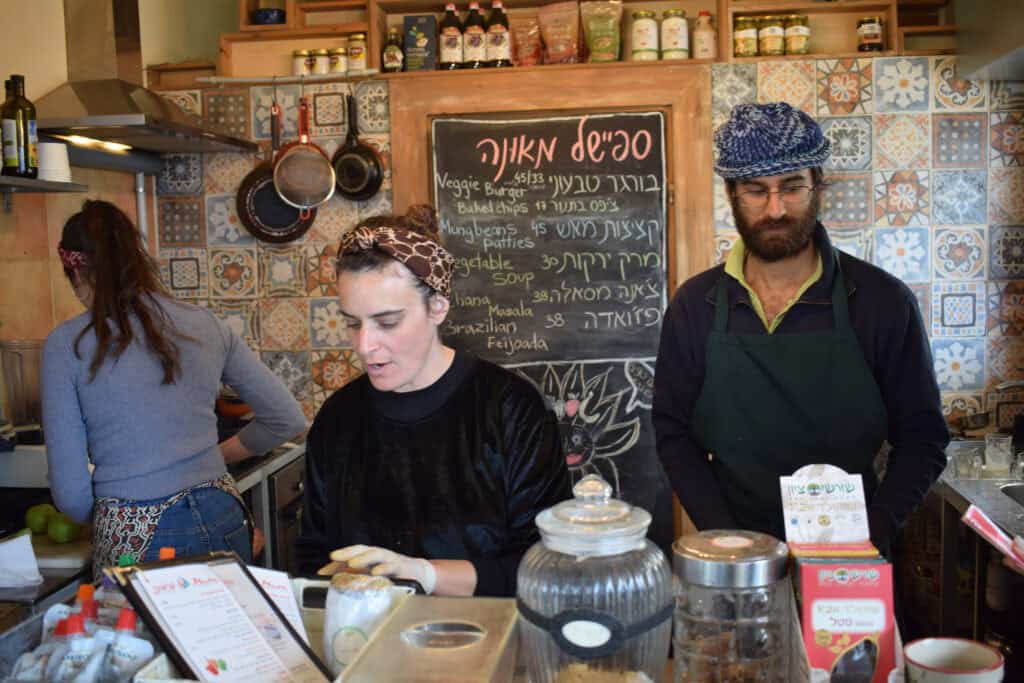
To our surprise, we arrived at a town in a blaze of action. Mitzpe was a non-stop party. On Friday morning, the Spice Routes neighborhood, named after the Nabatean Saudi Arabia-Mediterranean spice routes, a failed industrial park, turned into an ebullient social center. The streets of the neighborhood were filled with young people dancing to trance music—some with painted faces, and a bunch of barefoot kids running about. We watched as we waited for our iced coffee from one of the coffee shops next to a second-hand clothes store and a bakery, patiently waiting in the long coffee queue. No siren shattered the moment.
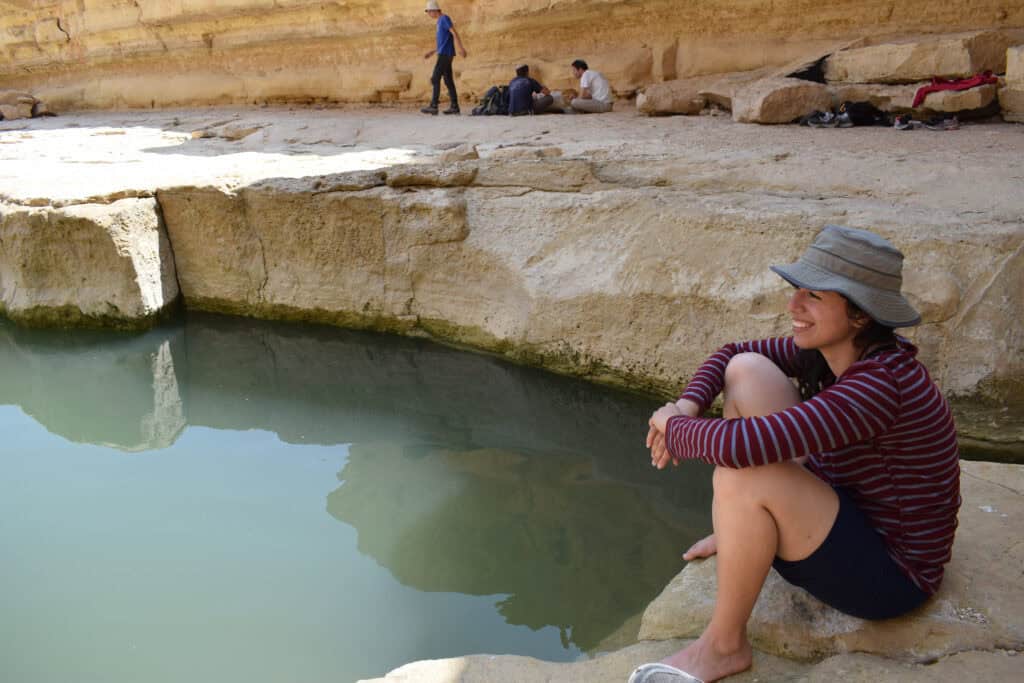
We continued on a trip to the Ein Yelek spring, actually a secluded pot hole that fills with water after rainy years. Around the spring, hidden in a little gulch, a group of young people was sitting around with beers and stories of the after-the-army trip that many of them had just returned from. Ayal, recently returned from a trek in South America, told us that the group had come together in the last few days in the local hostel. “We came here to get away from the war – to a place without sirens”. Each one of the young people, some just back in Israel, others just released from army service, had reached Mitzpe to find a few days of quiet.
“Sit next to us, and I will tell you a story,” says Ravit, a tall, tanned woman in her twenties, while another member of the group attempts to swim in the freezing spring. The group gathers around Ravit, while a sweet-smelling cigarette passes around. Ravit tells us about the beautiful beaches of Capurgana, Colombia, near the border with Panama, from where she had recently returned, straight into a war zone.
The brave guy trying the frozen waters of the spring lets out a shrill scream and exits quickly. The magic story moment of beautiful, faraway beaches is broken, and we pack up, trying to get back to Mitzpe before sunset. Ayal asks for a lift. Along the way, he tells us about his latest Euro-trip, still amazed by open borders and wide spaces, and by countries where security and safety are not fragile.
Camel Hill
Saturday morning, a week into the war, we make our way to Camel Hill, a local observatory overlooking the Maktesh, on a camel-shaped rock on the cliff edge. Religious families on their way to the synagogue dot the empty streets. On the hill, several families with children join us. We share our binoculars with the children for a closer view of the Negev Highlands. In such a small country, at the height of a war, it is difficult to believe that such a peaceful place exists. At this very moment, our cell phones start vibrating with missile warnings. But nothing breaks the silence. Mitzpe is not on anyone’s map.
Two hours later, I am seated on the porch of my friend’s vacation home. The desert winds carry the sounds of another party and the smells of a barbecue. On the other side of the road, in a construction lot with three unfinished houses, a lively Purim party is in full swing. “This is the meaning of life, dancing between the sirens,” one of the party-goers explains.
That evening at the local “Berekh” pub, a full-scale party is revving up– even though Home Front security regulations currently forbid gatherings of more than fifty people. The police arrived and decided to allow it, despite the regulations, which seem not applicable in Mitzpe. Michal, the waitress, who has been living in Mitzpe for the past two years while saving for circus studies, explains that parties at the pub are a nightly occurrence. “The only difference,” she adds, while clearing our table, “is that this week I don’t know everybody around the table.”
The pub, the only one in the Spice Routes neighborhood, is full. We try to find a place at the bar and settle for a table for two with Gal and Gilad, a young couple from Tel Aviv. Gal used to live in Mitzpe before moving to Tel Aviv. However, with the first siren, she moved back. Gilad joined her.
Gal, a doula by profession, had to return to Tel Aviv to assist a client giving birth. At the height of labor, the mother and the team had to make their way to the hospital shelter. She quickly returned to Mitzpe, to the clean desert air. “We are here without a deadline,” she says. “We will go back when it is safe again.”
Development Town
Mordechai was born and raised in Mitzpe. He is 18 and about to enlist in the Givati Brigade at the end of the month. He is currently hanging out at the pub with his friends. “Mitzpe is a fun place,” he says, “but the only time the town fills up is during a war.”
Actually, there is no place to hang out except the pub. “Why is this the only pub?” we ask. “There are not enough clients to go around for two,” he explains, “and another pub would only start a local war.”
In the last few years, a local war has indeed been fought in Mitzpe, between the religious and secular communities. “The growing religious community, which began settling in Mitzpe a decade ago, landed on a very secular, hippie-like community”, explains Mordechai. “Each community wants the town to have their characteristics – closed or open on the Sabbath, more synagogues instead of secular community centers, and more. Government ministries back the religious communities, and the secular population feels like they are fighting a losing battle. The two communities will have to live with each other,” explains Mordechai, “War is not appropriate for our beloved town”.
Mordechai gets up to dance in the interior room of the pub. The local community meets the Tel Aviv yuppies for a trance party in the desert. We join in and dance until the first light of the morning.
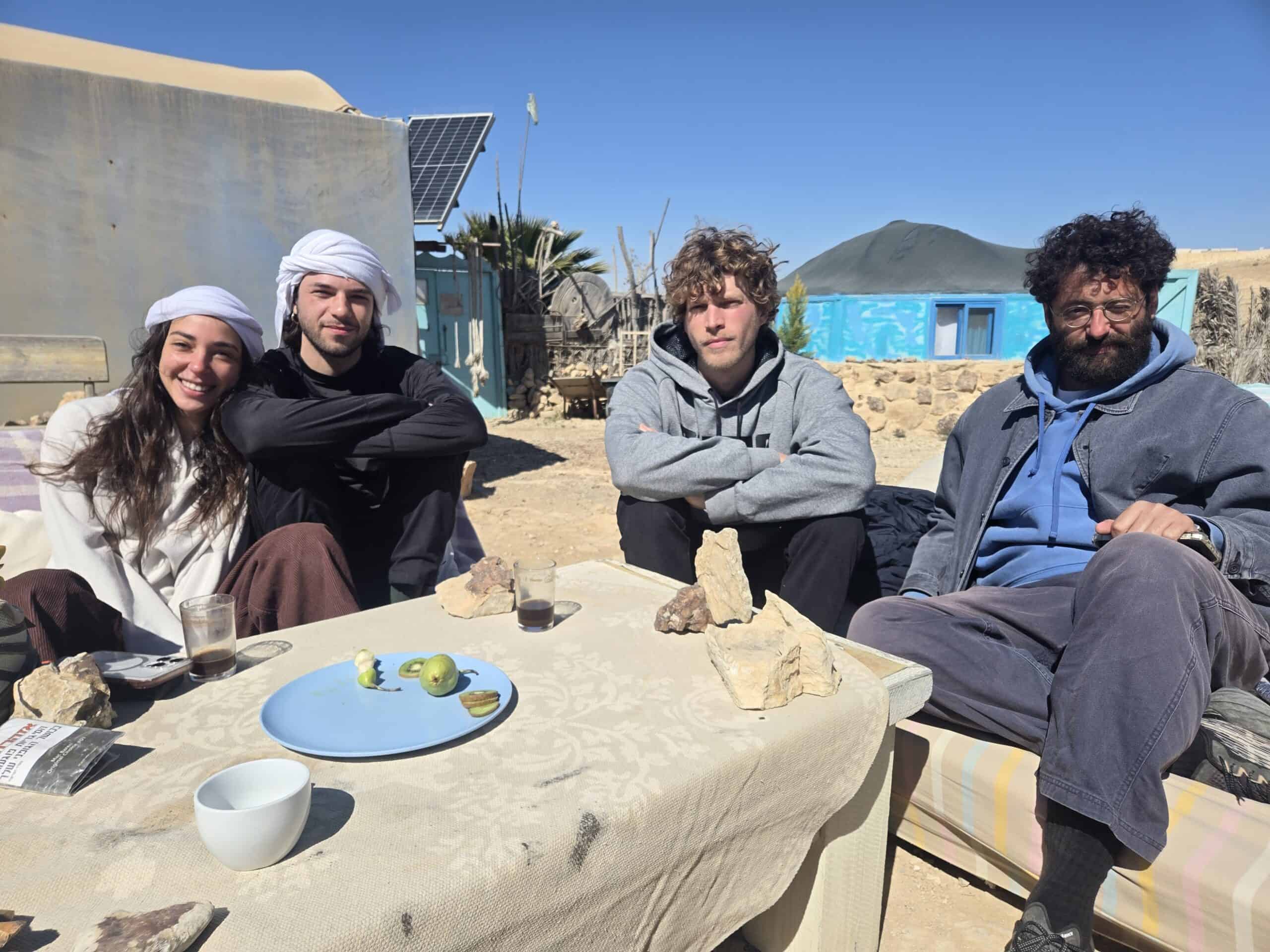
We start the next morning late, very late. The place feels like a vacation, and everyone here is a late starter. Passing through the ecotourism area, we find a local hostel. Cabins with no electricity, public outdoor showers, and a circle of old sofas open to the wind and sun. We meet Taliya Lin Ron, Yarden Tiger, and Nadav Tom Artshik, who made their way to Mitzpe with the first siren. The three are actors who met a film director, Pinhas Viya, in the hostel. They are now considering continuing south, to Eilat or the Sinai.
“We have been here for a week”, explains Taliya, “and it seems that we have had enough of the extreme quiet”—the discussion centers on films and advice on things to do. Very soon, the conversation turns to the events of October 7; for many of this generation, this is the moment that marks the start of their lives.
In the Spice Routes neighborhood, business goes on as usual. The streets are full, and the line for coffee is long. Standing in line at the local pastry shop, we listen to the omgoing conversation. “There was a missile strike in North Tel Aviv”, one woman tells her friend, “someone was hit, badly”. “We have asked to extend our stay here,” the friend adds, “but there is no available place. People are knocking on doors asking if there is a place to stay, with full payment.”
“Mitzpe is a good place for your Chapter Two,” A man in the line adds. “I wonder what Tinder offers here”. Black desert humour. Starting a new life in the desert. Maybe this will finally bring life to the small desert town perched on its cliff, where the only thing to do is trekking in the desert, enjoying the tranquility. Noa Borstein Hadad
Sirens again, dashing for the shelter. The previous war, nine months ago, caught us off guard, unsheltered. In general, neighborhood shelters are best avoided. They are dirty, damp, smelly, dark, and unsuitable for long-term occupancy. We vowed never to be caught that way again.
This time, we were ready. The lights in the shelter were fixed and working, and redundant sofas and chairs had been dragged in to make the stay more comfortable. One of the neighbors added a chest of old games from her storage room. The house committee brought an electrician ahead of time to add outlets for charging cell phones or for a heater or cooler. Beach chairs were neatly folded in the corner, and the non-standard wooden window was attached to the wall with large screws. No Iranian missile will be able to dislodge it.
With these improved conditions, the current battle with Iran feels different. On the one hand, screaming sirens still cut through our fractured lives. On the other hand, we have ceased to run hysterically to the shelter every time they go off. We stride confidently to the shelter nearest our building, or to our safe rooms, exercising our lives in the unique Israeli oxymoron called a state of Regular Emergency.
The Tel Aviv area is among the most targeted by missiles in the current confrontation. The resilient Tel Avivis, instead of waking up the kids and running for shelter four times a night, for a quarter of an hour each time, have found other ways to make the state of regular emergency easier. For example, setting up camp in the large public shelters constructed by the municipality, or the large underground parking lots, or the underground stations of Tel Aviv’s light rail. Car parks and train stations have been transformed into colorful, lively, and bustling depots.
Tel Aviv
At the Dizengoff Center parking lot, dance and yoga lessons were offered, offering peace of mind for body and soul. Very quickly, a local what’s-up community sprang to life with invitations for Shabbat services, free catering, and after-missile parties.
Throughout Tel Aviv, the social network buzzed with shelter ratings. “Nice local atmosphere and hospitality,” reported one Instagram follow-up; another mentioned “unpleasant smells” or “seating and water coolers” give me a like and recommend to a friend. A new wave of followers has been invented.
Other influencers gained their likes by inspection tours of public shelters. “Located 50 meters from the street”, ran one report. “During our visit, the shelter was clean, organized, and cool,” wrote another self-appointed shelter rater after a missile-break inspection of a shelter in the posh Bavli neighborhood in North Tel Aviv. “However, the shelter is small, especially for families with kids.” Join my followers for more reports.
“Warm and safe” was the rating for a shelter near Dizengoff Circle. “A very cute shelter. Not underground, but clean. I visited it during the 11 o’clock siren, and it was very crowded,” wrote Daniel this morning, rating a shelter in a South Tel Aviv neighborhood.
“This is a really hot shelter,” reported someone about a shelter in the cool Florentin neighborhood, “it doesn’t have an air conditioner.” Florentin excels at the highest number of shelter ratings, offering the most creative reviews. “Crowded during happy hour, empty during off-season. 100% protection with concrete vibes and a slight crowd,” reported a bar aficionado. A more poetic influencer notified his following that his local shelter had “Morgue lighting, Blender acoustics, and an Intoxicating smell of rats and cats (thanks to Mitzi the cat), no wifi, no air, but indie performances, and a pack of cute dogs. Bring wine, something to sit on, and something to nibble.” We will join with the next siren, answered one of the likes.
“Let me tell you of a secret shelter that everyone in Tel Aviv wants to know where it is,” wrote Tomer after the last attack. “Excellent location for meditation – a 20-minute detachment from the noise and tempo of the outside world – no wifi connection. There is also a VIP room with a little ventilation. I will return – if a missile doesn’t get me first”.
Meanwhile, on TikTok, the “Rate My Bomb-Shelter” trend is exploding. While making their way to the shelter, more and more people are sending photos and videos of their neighborhood haven, highlighting the latest additions and accoutrements, and asking to leave a rating for the shelter.
“After consulting with all the neighbors, I have decided to give our shelter a low rating”, explains a resident of the Kiryat Shalom neighborhood, “to avoid overcrowding,” he says with a smile. “There is a lot of space, but not enough chairs”. However, the attempt failed, and the shelter currently has a five-star rating.
The above-mentioned shelter, like many neighborhood shelters, is a microcosm of the political tendencies, beliefs, and arguments characteristic of Israeli society in recent years. The shelter has two parts: the right side, normally used as a synagogue, and the left side, used as a youth club. “In the beginning, everyone sat together, in the order of arrival. However, over time, the shelter divided”, reports a resident of the neighborhood, “the religious people who arrive without cellphones sit on the synagogue side of the shelter. They don’t adhere to the all-clear signal on the cell phone, but leave when they feel safe and protected. The secular residents sit on the youth club side of the shelter, which has wifi reception, and wait for the instructions from Home Command.”
The residents of this diverse neighborhood don’t argue about politics. They are divided over the door policy – or in more exact terms, when to close the shelter’s massive steel door. “The minute an early missile attack notice is sent, people begin to make their way to the shelter, in order not to be bottlenecked at the entrance when the siren sounds”, explains a resident. “The people who are already in the shelter want the door to be shut immediately. Others, at the bottleneck at the entrance, and others curious to watch the interceptors whooshing to the sky, stand outside and prefer to lock the door a few minutes after the siren. It is a heated argument with raised voices and fear”.
With all this new cultural shelter vibe, it is important to remember that thousands of people have been killed or wounded in the current conflict. Currently, in Israel, 11 people have been killed due to missile attacks and another 3,000 wounded. It seems the missile vibe is actually about alleviating the “Russian Roulette” fear of living under constant missile attacks.
In 1630, John Winthrop delivered the famous “City on a Hill” Sermon to the settlers about to set sail for New England. The Biblical quote “A city that is set on a hill cannot be hid” comes from Matthew 5:14 and was spoken by Jesus during the Sermon on the Mount. The city on the hill referred to in the Sermon was probably Susita, the city perched on a hill overlooking the Sea of Galilee and clearly visible from the surrounding area. John Winthrop and many American presidents have used this phrase to describe a country that spreads goodness to the world.
The same idea was at the base of the founding of the State of Israel. Herzl, Jabotinsky, Haim Weitzman, the philosopher Martin Buber, Albert Einstein, and many others envisioned the Jewish State as a center for spreading development and learning throughout the region and the world. My mother believed in it when she founded the Technical Assistance Department in the Ministry of Agriculture, bent on sending Israeli farmers to third world countries to teach modern agricultural methods – and my father believed in it, in a visionary letter to my mother in 1956 – that one day Israel will be at peace with its neighbors, a technical and economic hub in the Middle East.
Somewhere along the road, all these utopian ideas were derailed. It is easiest to blame it on the Arabs who did not agree to the creation of Israel, but, seventy-seven years later, sitting in my safe room with missiles raining down and interceptors whooshing up, it got me thinking as to why this is happening.
Over the years there have been many wars that we have won. But, only for a brief period in the 1980s, peace was in the air – a vibe quickly killed by extremists on both sides.
Missiles and bombs have become a way of life in the last two decades, with massive arsenals on both sides. We are constantly living in an oxymoronic status defined as “regular emergency”, which is gradually developing a unique culture of its own.
These next few articles are about the new “regular emergency” Israeli culture – a small psychological release from the pressure we are living in, remembering that there are many casualties from these attacks. People have been killed, wounded, and traumatized.
“The time has come, the Walrus said, to talk of many things.” Tweedledum and Tweedledee sang to Alice in Wonderland about The Carpenter and the Walrus, and indeed it seems that the time has come to rethink a lot of things, before, like the oysters in the poem, we will all be eaten up.
The Great Rebellion of the Jews against the Romans was not pre-planned. It started with a not-too-extraordinary riot in Jerusalem during Passover in 66 CE. During the Jewish pilgrimage festivals, the Romans stationed military forces in Jerusalem to control the crowds. But this time, when Roman soldiers tried to steal from the treasures of the Temple, violent riots broke out. The procurator, Gessius Florus, had to retreat with his forces to the safety of Herod’s palace. The Jews quickly took control of the Temple Mount and bottled up the procurator and his forces in the palace. King Agrippa, upon hearing of the riots, hurried to the city in order to try to convince the people that fighting Rome was of no avail. But as he was trying to placate the Jerusalemites, a group of Sicarii, led by Menahem of Gamla, managed to overcome the Roman garrison in Masada, take possession of the large quantities of weapons stored there, and hurry to Jerusalem with the weapons. While the Sicarii were on their way, local anti-Roman priests stopped the daily sacrifices for the well-being of the emperor. The rebellion against Rome was now official. Once Menahem and his Sicarii arrived in the city, the palaces of the high priest, of Agrippa, and of his sister Bernice were torched, together with the city archive that contained all records of debts and loans. The Roman garrison, still holding out in the Antonia Fortress that overlooked the great Temple platform, was attacked. After two days of fighting, the fortress fell and the remainder of the Roman defenders retreated to Herod’s palace. The Roman soldiers agreed to put down their weapons in return for safe conduct out of the city, but once they allowed the rebels into the palace, they were all slaughtered. The rebellion spread throughout the country. In the cities with both Jewish and pagan communities, riots broke out between Jews, Samaritans, and Pagans. When it became clear that the local Roman forces could not restore order, Cestius Gallus, the governor of Syria, set out for Judea at the head of the Twelfth Roman Legion and auxiliary forces. After restoring a semblance of order along the coast, he arrived in Jerusalem during the Feast of Tabernacles. When he failed to break into the city, he decided, for no apparent reason, to retreat – which turned his entire military campaign into a fiasco. The Jews pursued the retreating Romans and attacked as the legion made its way down to the coastal plain. Some 6,000 Roman legionnaires fell in the battle and the rebels gained a supply of armor, weapons, and military equipment. The victory united all the factions of the Jewish population. A provisional government was set up and governors were sent to different parts of the country. Jerusalem was put under the command of Joseph, son of Gorion, and the high priest, Hanan; Edom was given to Joshua, son of Sapphias and the priest Elazar ben Hanania. Joseph, son of Matityahu, the future historian Josephus Flavius, was put in charge of the Galilee. In the spring of 67 CE, Nero put his most seasoned general, Vespasian, at the head of the 60,000-man military force that would be sent to Judea to suppress the rebellion. Vespasian started his offense by landing, unhindered, in Acre. Marching into the Galilee, he first came upon Sepphoris, which from the start had leaned towards the Romans, and took control of the town. From the outset, the Jewish forces had no chance against the might of Rome – their only hope was to ambush the Romans as they marched and to try to hold out in fortified cities against the legionnaires. To do so an experienced and united military command was needed – Josephus was no military commander. Yodefat, the stronghold that he personally commanded, held out for a few months of bitter fighting, but finally succumbed in the summer of 67 CE. Josephus turned himself over to the Romans and became the official Roman historian of the war, writing under the name Josephus Flavius – the family name of Vespasian. After Yodefat’s fall, Tiberias surrendered to the Romans. The neighboring town of Trichea (Magdala), resisted. When the town fell, the defenders continued fighting from boats on the Sea of Galilee until the Romans built a fleet and put an end to the last source of resistance around the lake. Gamla, the stronghold of the Sicarii on the Golan Heights, was then put under siege. After a bitter battle, the Romans managed to make their way into the hilltop town. The surviving defenders gathered at the top of the cliff around which the town was built, and jumped to their deaths. The Romans then moved on to Tabor and Giscala (Gush Halav) in the Upper Galilee. Gush Halav was the hometown of John of Giscala, Josephus’s old rival for the leadership in the Galilee. By this point, however, John had moved on to Jerusalem to organize the defense of the capital. The debacle in the Galilee prompted an outbreak of violence in Jerusalem, with the extremists accusing the more moderate factions, mainly composed of the priests and the wealthy, of not wholeheartedly supporting the rebellion and secretly harboring the desire to surrender to the Romans. Civil war broke out in the city. Vespasian let his armies rest during the winter and continued the conquest of the rest of the land in the spring of 68 CE. He split his forces in order to execute a pincer maneuver, sending one force to make its way along the coast and the other to proceed via the Jordan Valley. By the end of 68 CE, the only territories still under rebel control were Jerusalem and the Judean Desert. Meanwhile, despite the imminent approach of the Roman legions, the civil war in Jerusalem continued. During the year spanning 68 and 69 CE, dramatic events unfolded in Rome. Nero died and four different emperors ascended the throne in the year after his death. The fourth was Vespasian, nominated to the throne by his troops. Vespasian left the conduct of the war in Judea to his son Titus. The Jewish forces did not take advantage of this year of inactivity to organize the defense of Jerusalem. The leaders of the three main Jewish factions – John of Giscala, Eleazar ben Simon, and Simon bar Giora – continued fighting among themselves, each one controlling a different part of the city. The battle of Jerusalem started in the summer of 70 CE, when Titus besieged the city for five months. When the Jews managed to destroy the Roman ramps and siege engines, Titus decided to starve the city and surrounded it with a siege wall. In August, the Romans managed to capture the great Antonia Fortress. After the fall of the fortress, they conquered and set fire to the Temple. The upper city held out for another month, but it was clear that the battle was over. The city was set ablaze and Jerusalem was destroyed. Herod’s magnificent Temple was no more. Two fortresses south of Jerusalem still remained in the hands of the rebels: Machaerus, on the eastern side of the Dead Sea; and Masada, on the western side. Three years after the rebellion, in 72 or 73 CE, the Romans stamped out this last bastion of resistance.
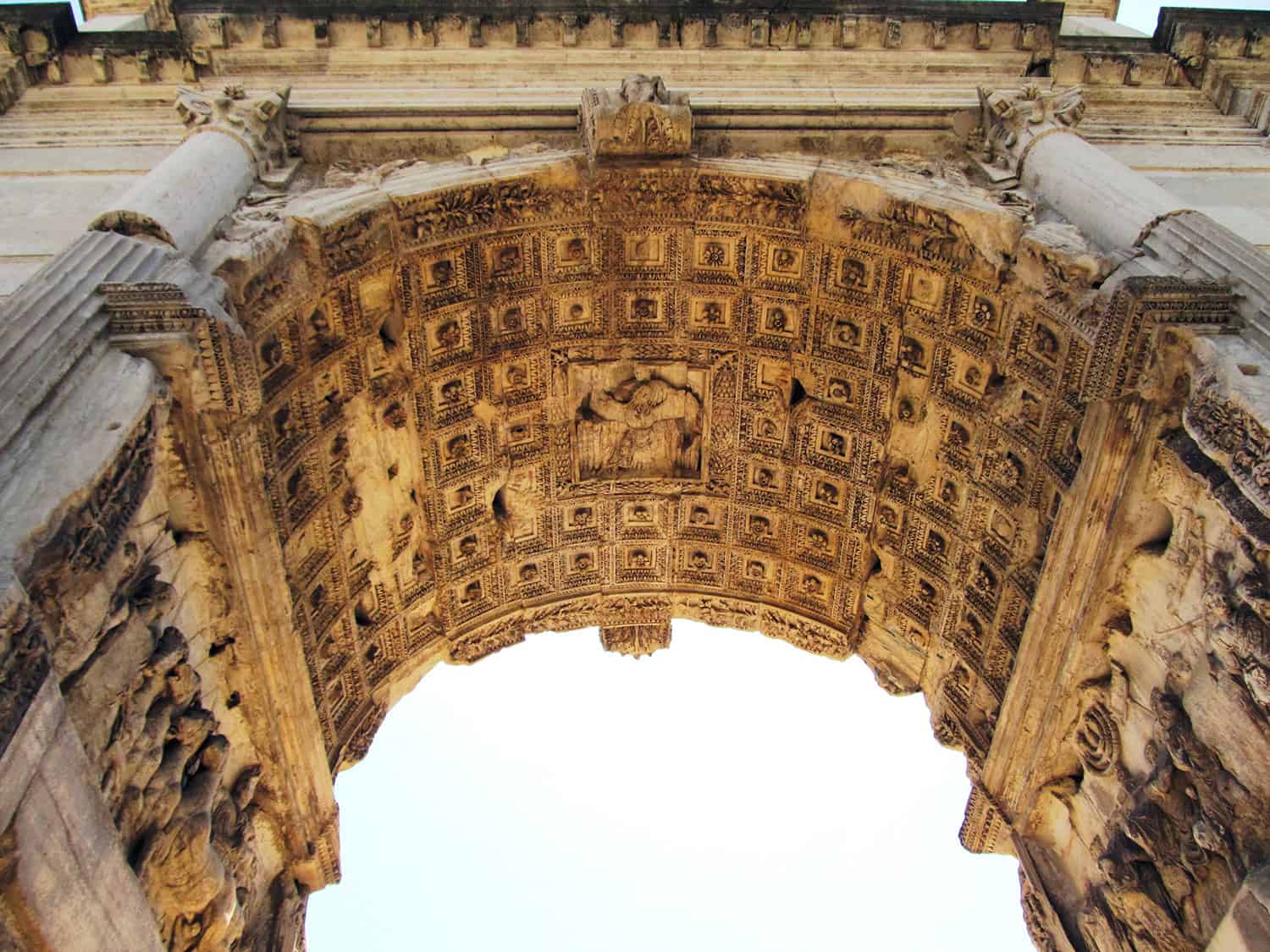
The oldest-known depiction of the menorah and the sacred vessels from the Second Temple in Jerusalem appear on one of the bas-reliefs adorning the Arch of Titus in the Roman Forum. This arch was erected in the first century CE to commemorate Titus’s conquest and destruction of Jerusalem and the Temple. This past spring, a second Arch of Titus was discovered in Rome. This one stood in the Circus Maximus stadium and it too commemorates the conquest of Jerusalem. This discovery, along with recently completed research confirming that the menorah in the bas-relief originally was painted a golden yellow to emphasize that it had been crafted from pure gold, sheds new light on this distinctive architectural element. > by Yadin Roman
The eve of Hanukka on December 23, 1997, was clear and starry in Rome. A group of people was gathered in the Roman Forum next to the Arch of Titus, which stands on the Via Sacra leading to the Temple of Jupiter on Capitoline Hill. Roman emperor Domitian is credited with erecting this arch in 81 CE to commemorate the deification of his brother Titus and his conquest and destruction of Jerusalem. For hundreds of years, perhaps even since the arch was completed, the rabbis of the Jewish community in Roman strictly forbade their followers from walking under the arch. Anyone who violated this ban was considered to have left Judaism and his or her soul was cut off from the Jewish people. The group that gathered by the arch on the eve of Hanukka in 1997 included then-Italian prime minister Romano Prodi, then-mayor of Rome Francesco Rutelli, Italian dignitaries, the rabbis of Rome, and the city’s entire Jewish community. In an impressive, joyous ceremony full of light, the ban on walking under the arch was formally revoked in honor of the fiftieth anniversary of the establishment of the State of Israel. The time has come to remember the tragedy of the Holocaust and reaffirm the right of all people to live in peace and dignity in all places, the Italian prime minister declared in his speech at the ceremony. “When many people look at the sculpture under the arch,” the mayor said, “they only see the misery inflicted upon a conquered race. But look again. I see not a conquered race, but a monument to one of the greatest modern nations on earth. The conquering Romans are a footnote of history, but the Jewish nation continues to thrive, within and outside the State of Israel. That is what the arch represents to me.” After the ceremony, some Roman Jews peeked at the reliefs, which are located on the underside of the arch, but could not bring themselves to actually walk through it. The Arch of Titus is one of the 36 triumphal arches that stood in Rome in the fourth century CE, before the glory of the empire that the city’s sons had established faded. Only three of these arches still are standing today: the Arch of Titus; the Arch of Septimius Severus, which was erected in 203-205 CE; and the Arch of Constantine, which was constructed in 312 CE. The Roman triumphal arch is one of the innovations that the Romans gave to the world of architecture. Triumphal gates had been known for thousands of years before the days of Rome. Hittite, Assyrian, and Babylonian kings would boast of their victories by building monuments adorned with inscriptions and depictions relating the story of their triumphs. The Etruscans, the ancient tribe that the Romans conquered at the beginning of their rise, would erect such monuments at the entrances to their cities or on central streets as stand-alone elements not connected to a wall or a building. The Roman triumphal arch was a distinctive development because it brought together two elements that had never been seen together before: a round arch mounted on two columns or piers and a large square assemblage on top of it. These two elements had been used separately in the ancient world for hundreds of years. Arches appeared in canals and water drainage systems and as an engineering element to lower the pressure on openings in a wall such as windows and entranceways. The upper structure of the arch, a beam that connects two columns, could be seen in Greek temples as part of the system that held up the roof and provided a place for reliefs and decorations. Sculptures of gods or of the emperor were installed above the Roman triumphal arch. The sculptures on the Arch of Titus in the Roman Forum disappeared over the ages, but examples of this can be seen in the 40 odd triumphal arches erected in the world’s capitals, almost all of which were inspired by the Arch of Titus. They include the Arc de Triomphe in Paris; the Brandenburg Gate in Berlin; the triumphal arches in Saint Petersburg, Moscow, New York, London, New Delhi, and Brussels; as well as the arches in numerous other countries, such as Hungary, Italy, Iraq, Laos, Macedonia, the Philippines, Portugal, Romania, and Australia, to name a few. The first Roman triumphal arches were erected in the days of the republic by leaders and military commanders who saved the city or presided over important victories. They built monuments to commemorate their valor themselves. However, when the republic became an empire, emperor Augustus ordered that triumphal arches only be built for emperors – and only after the Senate had approved the convening of a triumphal march, known as a triumph, for them. The triumphal arch thus transformed from a personal symbol to a tool of governmental rule. Rome built imperial arches in public places, such as on main roads, at squares, at the entrances to stadiums, and so on. The goal was for the public to pass through the arch and be impressed by the message that this public monument was intended to convey. The Triumph Titus Flavius Caesar rose to power on June 23, 79 CE, following the death of his father, emperor Vespasian. In 67 CE, 13 years earlier, emperor Nero had sent Vespasian to the province of Judea to quell the Jews’ revolt. At the time, Vespasian, then 57, already had retired from public life. He had distinguished himself in his youth as a military commander fighting in Germany and participating in the invasion of England. In 63 CE, Vespasian was appointed governor of Africa. After completing his term in Africa, he returned to Rome. Vespasian was not from a wealthy family; his weak financial position after retiring from public office forced him to earn a living by trading in mules, but his business dealings were unsuccessful. Meanwhile, he was invited to join Nero’s entourage on a trip to Greece. During the visit, Vespasian was caught dozing at one of the mad emperor’s theater or musical performances and was forced to flee for his life. After the revolt broke out in Judea, and the Jewish rebels defeated the Roman governor in Syria, Nero summoned the disgraced Vespasian to duty, handing him command of the legions in the east. Nero did not choose Vespasian by chance: a military commander who was not a member of the Roman nobility was not considered a threat to the emperor. Vespasian had his oldest son, Titus, join his forces. Two years after the rebellion broke out, in 68 CE, Nero committed suicide. The empire deteriorated during a series of power struggles in a period that became known as the Year of the Four Emperors. The first to take power were the commanders of the western legions. When they did not succeed to stabilize the empire – and were murdered, one after the other – the legions in Alexandria declared Vespasian the new emperor. The legions of the east quickly joined them. Vitellius, the last of the three emperors who preceded Vespasian, was murdered and Vespasian was named emperor on July 1, 69 CE. The new emperor left his son Titus in Judea to finish the war against the Jews. During 70 CE, Titus conquered the Jordan Valley and the approach to Jericho and the Dead Sea and then set siege to Jerusalem. After a five-month siege, and the death of thousands of the city’s residents in battle and from starvation, Jerusalem fell. The Roman legions slaughtered or enslaved the surviving Jerusalemites, demolished the city’s buildings, and destroyed the magnificent Second Temple that Herod had built. Titus returned to Rome a hero, accompanied by his Jewish mistress, Bernice, the daughter of king Agrippa I and the great-granddaughter of Herod and Mariamne the Hasmonean, and Josephus Flavius, who was appointed the imperial court historian. The city honored Vespasian and Titus for the victory in Judea with a grand triumph: a procession of the legions and thousands of Jewish captives as well as a display of the great treasures plundered in the war, including the sacred Temple vessels. At the end of the victory procession, Simeon Bar Giora, who the Romans had identified as the military commander of the rebellion, was executed. Josephus provides a detailed description of the triumph in his book, The Jewish War (Book VII, 132-162, from H. St. J. Thackeray’s translation from the Greek, Loeb Classical Library, 2004). “It is impossible adequately to describe the multitude of those spectacles and their magnificence under every conceivable aspect,” Josephus writes before offering a survey of the wealth of gold, silver, and ivory vessels, tapestries dyed with the rare purple dye, precious stones, and sculptures. The procession also included many species of animals and multitudes of finely dressed people, including the captives, Josephus continues, noting, “the variety and beauty of their dresses concealing from view any unsightliness arising from bodily disfigurement.” Soldiers carried huge mobile stages depicting the story of the war in which “a prosperous country was devastated, … also every place full of slaughter…. The spoils in general were borne in promiscuous heaps; but conspicuous above all stood out those captured in the temple at Jerusalem. These consisted of a golden table, many talents in weight, and a lampstead [the menorah], likewise made of gold, but constructed on a different pattern from those which we use in ordinary life. Affixed to a pedestal was a central shaft, from which there extended slender branches, arranged trident-fashion, a wrought lamp being attached to the extremity of each branch; of these there were seven, indicating the honour paid to that number among the Jews. After these, and last of the spoils, was carried a copy the Jewish Law [a Torah scroll]…. “The triumphal procession ended at the temple of Jupiter Capitolinus, on reaching which they halted; for it was a time-honoured custom to wait there until the execution of the enemy’s general was announced. This was Simon, son of Gioras, who had just figured in the pageant among the prisoners, and then, with a halter thrown over him and scourged meanwhile by his conductors, had been hauled to the spot abutting on the Forum, where Roman law requires that malefactors condemned to death should be executed. After the announcement that Simon was no more and the shouts of universal applause which greeted it, the princes [Vespasian and Titus] began the sacrifices, which having been duly offered with the customary prayers, they withdrew to the palace.” After the triumphal festivities ended, Vespasian built a temple to peace and “Here, too, he laid up the vessels of gold from the temple of the Jews, on which he prided himself; but their Law [Torah scroll] and the purple hangings of the sanctuary he ordered to be deposited and kept in the palace.” Vespasian used the extensive spoils from the Second Temple to finance building the grand Colosseum stadium. When he died in 79 CE, Titus succeeded him; this was the first time in the Roman empire that a son succeeded his father. Titus ruled for only two years, during which he faithfully dealt with the victims of the eruption of the volcano of Mount Vesuvius in 79 CE, the great fire that broke out in Rome in 80 CE, and the victims of the plague that swept his empire. He also completed the construction of the Colosseum before his death in September 81 CE. Domitian, the brother of Titus, succeeded him. Today it is commonly accepted that he erected the Arch of Titus in the Roman Forum shortly after his brother’s death. The arch commemorates the deification of Titus – something which happens after his death – and so the accepted explanation is that Domitian built it to reinforce his connection to the acts of valor performed by his father and brother, acts that won him the throne. The Temple Menorah The Arch of Titus in the Roman Forum has a monumental inscription on its facade: “The Senate and the People of Rome to the late divine Titus Vespasian, Augustus, son of the late divine Vespasian.” The inscription on the opposite side of the arch was added much later, after the arch was restored in 1882, after having been used for generations as part of the wall surrounding the estate of a wealthy resident of Rome. This inscription describes the restoration work, which was performed at the orders of pope Pius VII. When one walks under the arch and looks up, there is a relief in the center of the underside depicting the deification of Titus. However, the arch’s main significance comes from two other reliefs, which are located high up on the inner sides of the arch. Both of these reliefs depict the triumph to celebrate crushing the rebellion in Judea. One shows Titus riding a chariot harnessed to four white horses with an eagle, the symbol of Roman power, perched on his shoulder. Soldiers are depicted marching alongside the chariot and in front of it are rows of captives. The second relief shows Roman soldiers carrying the sacred vessels of the Temple, with the golden menorah at the center, surrounded by the table of the shew bread, trumpets, and incense shovels. This is the oldest known depiction of the sacred Temple vessels, leading researchers to accept it as an accurate depiction of the menorah that stood in the Second Temple. However, as more and more ancient synagogues were dug up by archaeologists, a different kind of menorah came to light, this time depicted on the mosaic floors of these synagogues from the talmudic period. These mosaic menorahs, which were dated to later periods than the Arch of Titus, were shown standing on three legs, not on a base, as it is shown on the Arch of Titus. A very active debate on the topic has been underway for decades – did the Jewish mosaic floor artists get it wrong? Some claim that the base seen on the menorah in the arch is simply a box that was built around the menorah so that it could be carried easily in the triumph. The latest of the many studies of the menorah on the Arch of Titus was conducted in June 2012 by a team of archaeologists from Yeshivah University in New York, US, working with archaeologists from Rome. They performed high-resolution, three-dimensional scans of the reliefs of the menorah and the deification. One of their most interesting findings was the discovery of traces of yellow ochre on the menorah’s base and arms. It turns out that the menorah was painted a golden yellow, including the base, as befits an item made of pure gold. Who Built the Arch of Titus? There is no doubt that the Arch of Titus was erected in the Roman Forum after the death of Titus. The emperor was deified only after his death and the inscription in the arch refers to “the divine Titus Vespasian” as does the relief in the ceiling of the arch showing the deification of Titus. Many concluded that the other Arch of Titus, the one that had stood at the great Circus Maximus arena, was the one dedicated to Titus during his lifetime. In the Middle Ages, it still was possible to see this arch and an anonymous source who visited ancient Rome preserved the inscription that was carved on it: “The Senate and the People of Rome dedicate this arch to the emperor Titus Caesar, son of the divine Vespasian, Augustus, the high priest, holding authority in the tenth tribune, the seventeenth emperor, the eighth consul, father of the homeland, ruler of the nation, since according to his father’s command and the advice of fate he subdued the Jewish people and destroyed the city of Jerusalem, a city that was assailed in vain before him by military commanders, kings, and nations.” In this inscription, Vespasian is divine, while Titus is the emperor, which could be a hint that the arch was built during the lifetime of Titus and by Titus. Until recently, it was assumed that this arch had been completed destroyed and its stones were looted to be used in other structures. However, this year, the base of an arch was found three meters below ground level on the eastern side of the Circus Maximus, which archaeologists believe is the missing second arch. Over 300 fragments of marble that had been part of the arch were scattered across a large area surrounding the foundation. Some of these fragments are several meters long. Judging by the foundation, this arch was 17 meters wide and 15 meters long. There is no doubt that emperors and military commanders once walked under this arch in triumphal processions on their way to the temple on Capitoline Hill. This arch too most likely was adorned with reliefs depicting the destruction of Jerusalem and the Second Temple. If Titus built the arch in the Circus Maximus to commemorate his victory over the Jewish people and the destruction of Jerusalem, it is not clear why another arch was constructed after his death commemorating the same exact event. Like most historic dilemmas, there is not a simple, obvious answer. Donald McFayden of the University of Chicago in the US wrote one of the few studies that addresses when the arches were constructed. It was published a century ago, in 1915, in The Classical Journal. McFayden notes that the list of buildings mentioned as being constructed by Domitian in Latin sources makes no mention of these arches. Furthermore, in one of the writings of the Roman poet Martial from 85/86 CE, he explains to a servant the route from his home to the home of a friend on Capitoline Hill. Martial describes all the buildings that the messenger must pass on the way to his friend’s home. The route goes right by the Arch of Titus in the Roman Forum, but he does not mention the arch. The Roman historian Suetonius, who wrote in the second century CE, also hints that Domitian did not build the arch. Since the arch expresses the sorrow of the people of Rome and the Senate over the death of Titus, who was one of the most beloved of the Roman emperors, researchers assumed that it was only logical that it had been built immediately after his death, when the mourning for him was assumed to be strongest. However, that does not take into account Domitian’s personality. Suetonius explicitly writes that Domitian was jealous of his father and Titus for their military achievements, which he was not a partner to. Domitian tended to play down the importance of the victory in Judea, claiming that Vespasian and Titus actually owe their ascent to power to him because while they were in the east, he remained in Rome and worked to have power transferred to Vespasian. If he hated his brother, it does not make sense for him to erect an arch to commemorate his achievements. The inscriptions on the arches also raise another problem. The inscription on the arch in Circus Maximus mentions that Titus only completed the work that his father began before him. The arch in the Roman Forum, however, only mentions Titus in the inscription and he is depicted riding alone in the triumphal carriage and being honored for his triumphs. Titus was only his father’s representative (legatus) when he conquered Jerusalem. In Roman law, a triumph achieved by a representative is considered the triumph of the person who sent him into battle. In other words, Vespasian was the great victor of the war in Judea and only he deserved to receive a triumphal parade for it. It does not seem logical that Domitian would agree to give Titus all the credit for the victory in Judea, mainly because he did not deserve it. At the very least, if he had completed the arch in the Roman Forum that Titus had started to build, he would have corrected this disregard for protocol in its inscription. Domitian’s sole claim to the throne was that he was the son of the Flavian family, a family which was not part of Rome’s nobility. For Domitian, the only way to justify his rule was deifying his family. Domitian asserted that his family was worthy to rule due to its divine origins, not due to the victory in Judea. He reinforced his understanding of divinity by cultivating the cult of the emperor, building two temples in Rome dedicated to this cult and founding a priestly order whose purpose was the worship of the Flavian emperors. Historians of the time describe Domitian as one of the most hated emperors by the residents of Rome and the empire. Romans would secretly express their loathing of Domitian by praising his brother Titus, the benevolent and loved emperor. Meanwhile, opposition to Domitian grew stronger among circles in the Roman nobility, which gave rise to several attempts to assassinate him. Domitian responded by executing and exiling the suspects and confiscating their property. The last three years of his rule were characterized by severe persecution of the nobility and the senators. They finally rebelled against the emperor and assassinated him in 96 CE. Following Domitian’s death, the Senate selected Nerva to serve as the new emperor. A member of the Senate and the scion of a noble family, Nerva needed to calm the army, which was loyal to the Flavian family, and strengthen his rapport with the most respected commander in the army in those days, Trajan. When Nerva died only two years later in 98 CE, Trajan succeeded him as emperor. In the years following Domitian’s death, the Senate destroyed all traces of the dark days of his rule. His statues were removed from public squares and his name was removed from inscriptions. Historians of the time, such Tacitus, Pliny the Younger, Juvenal, and Suetonius, joined the campaign, painting a dark picture of Domitian. With time, Domitian became known as a cowardly, cruel, and perverse tyrant, though modern historic research has found he was an effective administrator and that the empire actually flourished during his reign. Expressing hatred of Domitian by presenting his brother Titus as the “darling of the human race,” in the words of Suetonius, also continued during this time. Worship of Titus, which had been neglected during his brother’s reign, was renewed and he was considered the one who stood at the head of the Flavian dynasty. Since it was possible to credit Titus, and only Titus, with the great victory over the Jews during the reign of Nerva or the beginning of the reign of Trajan, that may be when the triumphal arch in the Roman Forum that praises only Titus, and not Vespasian, was erected. Amnon and Ruth in the Jezreel Valley The Hanukka ceremony in 1997 completed a process that began when the Jewish Brigade of the British Army, made up of soldiers from the Land of Israel, arrived in Rome in 1944. Its soldiers marched under the Arch of Titus as a group, in defiance of the ban. That same year, Isaac Ben Israel, a member of the Jewish Brigade, wrote the Hebrew poem, “All Roads Lead to Rome.” Zvi Ben Yosef put it to music and Hannah Meron and Yossi Yadin, who were indeed “a couple in love” then, performed it, singing:
“A couple in love, two Sabras from Canaan, Ruth and Amnon from the Jezreel Valley Take a trip never taken before To the Arch of Titus at midnight! And under the Arch of Titus, in the shadow of the antiquities Kisses bloomed – what else is there to wait for Oh Titus, Titus, if you had seen, To who is the triumph, to who are the songs of praise By the arch that you built A couple in love from the land of Israel By the arch that the respected emperor built then A pair of soldiers from the Land of Israel.”
The day that the State of Israel was established, May 15, 1948, the Jews of Rome also flouted the ban and marched under the Arch of Titus in the opposite direction of the triumphal procession, from the Roman Forum towards the Land of Israel. The following year, brothers Gabriel and Maxime Shamir designed the official symbol of the new state. At its center is the seven-branched menorah, as it appears on the Arch of Titus. The menorah that was taken to Rome and that symbolized the destruction of Jerusalem in 70 CE thus returned symbolically to Israel upon the renewal of the Jewish people in its land.
Over the past year, civil society in Israel has emerged from the shadows. It has always existed, but social solidarity, mutual aid, and unity have all crumbled in the last three decades, and the essential need for civil organizations has become central to safeguarding our democracy. The attempted judicial revolution and the massacre of October 7 placed a mirror in front of us through which we could see the reflection of our society. It was a broken view, shattering to pieces all that we believed about the resilience of Israel. For many, it was a wake-up call to take action. Since its founding 40 years ago, “ERETZ Magazine” has focused on the history, heritage, and culture of the Land of Israel. However, it is impossible to ignore the enormous changes that are taking place and still be faithful to our editorial mission: Yediat Ha-Aretz – Knowledge of the Land. In this issue, we focused on a few lesser-known aspects of Israel’s civic society that illustrate the overall atmosphere. Two weeks after October 7, Talya Yarom, a senior event producer, decided to hold a concert with a thousand musicians and singers at the Roman Theater in Caesarea to express the need for the immediate return of the hostages. All concert participants, singers, stage people, film crews, and editing crews did their work voluntarily. The concert received millions of views online. Liri Roman, whose sister Yarden and sister-in-law Carmel were held hostage in Gaza, decided to set up a giant sand clock to illustrate that time is running out for the hostages. Today, sand clocks are displayed in Tel Aviv, New York, and Berlin. Five more are about to go up in Israel. Shomrim, the Center for Media and Democracy, decided to establish an emergency fund to provide emotional assistance for journalists and media personnel exposed to the atrocities of October 7. The fund raised 400 thousand dollars, enough to aid nearly 200 journalists. The story of Kibbutz Manara, its members evacuated from their Lebanese border home and settled as a kibbutz within a kibbutz at Kibbutz Gadot, illustrates the strength of the Kibbutz Movement, that with a new General Secretary plans to take the lead in Israeli society, and shape the values needed to repair our shattered mirror. I must disclose that I have personal connections to all these stories. The Caesarea Theater played an important part in our Caesarea issue. Gili Roman is my brother’s son. One of an amazing group of young people who left whatever they were doing to fight for the release of the hostages. I learned about the emergency fund of Shomrim from my wife, who works there, and I have a particularly warm place for Manara, where I grew up. Special thanks go to my friend and army buddy, Zvika Tzur, from Kibbutz Gvat. Without his amazing efficiency and sage advice, many of these articles would not have made their way to print.
From ERETZ magazine – issue no. 187 – December 2023
My mother was an avid fan of Aldous Huxley. A dozen of his novels in hardcover and matching jackets stood on a library shelf in my childhood home. My mother even corresponded with Huxley in the early 1940s. I had never read any of the books; however, one name on the book-backs drew my attention: “Eyeless in Gaza.” I wondered why this English author wrote about Gaza. Eventually, I learned that the book was not about Gaza but about a young English socialite who had lost his way in life. Huxley, who was half-blind in one eye, dwelled a lot on the blindness inflicted on society by the principles of mass production and Pavlovian conditioning. The book’s title was from a verse in the drama “Samson Agonistes,” written by John Milton in 1671. Milton depicts the biblical Samson, the once-mighty warrior, as blinded and a prisoner of the Philistines (“eyeless in Gaza at the mill with slaves”).
The same motive appears in a 1991 collection of essays by Shulamit Har-Even. In the title essay, “Blind in Gaza,” Har-Even tells of a visit to a family in the Rimal quarter in Gaza during the Israeli occupation.
Last winter, with my wife, I set out on a trip to Kibbutz Be’eri. It was a spontaneous last-minute decision, and my niece Yarden, who lives on the Kibbutz, was absent. However, we drove along the green fields surrounding the Kibbutz, descended to the “Concrete Road” built by the British in preparation for the Second World War, visited Nakhabir – the original site of Be’eri, and continued to the memorial to the Australian and New Zealand soldiers who had fought at Gaza during the First World War. The monument is just off the security barrier around Gaza, and I felt slightly uneasy as we climbed the steps to the top of the memorial.
On October 7, my niece, her three-year-old daughter Geffen, and her husband Alon were taken hostage at Be’eri. Five terrorists forced them into a car and sped toward Gaza along the same road we had taken a few months earlier. On the way, an Israeli tank appeared, and the terrorists halted for a minute. Yarden, with Geffen in her arms, and Alon, jumped out of the vehicle and ran. The terrorists opened fire and gave chase. After a few moments, Yarden handed Geffen to Alon. “Run for your life she told him.” Yarden took shelter from the bullets behind a tree and was captured and taken to Gaza. Alon and Geffen managed to escape.
Somehow, the tragedy of that day, with thousands killed and wounded and nearly 250 taken hostage, brought me back to thinking about Samson, eyeless and chained in the Philistine temple in Gaza. Why were we so blind, shorn of our ability and strength?
Huxley’s most famous work, “Brave New World” is an Orwellian dystopian novel. However, the time has come for us to create a different New World. A world that will bring us back to the ideals that were our country’s core: social justice, innovative agriculture, education and science, and a quest for peace.
I hope that we will manage to release all the hostages and overcome the Hamas and Hezbollah. Then, we can finally put ourselves to the difficult task of regaining our vision, rebuilding, and rejuvenating our country with the ideals that gave us our strength.
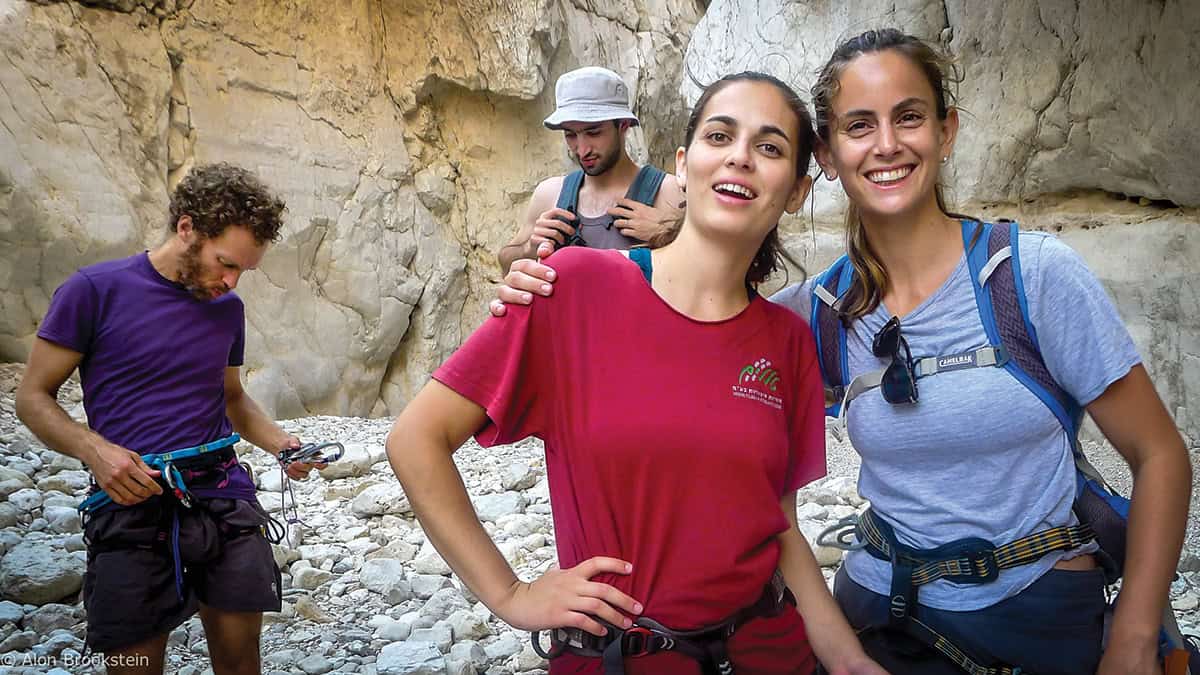
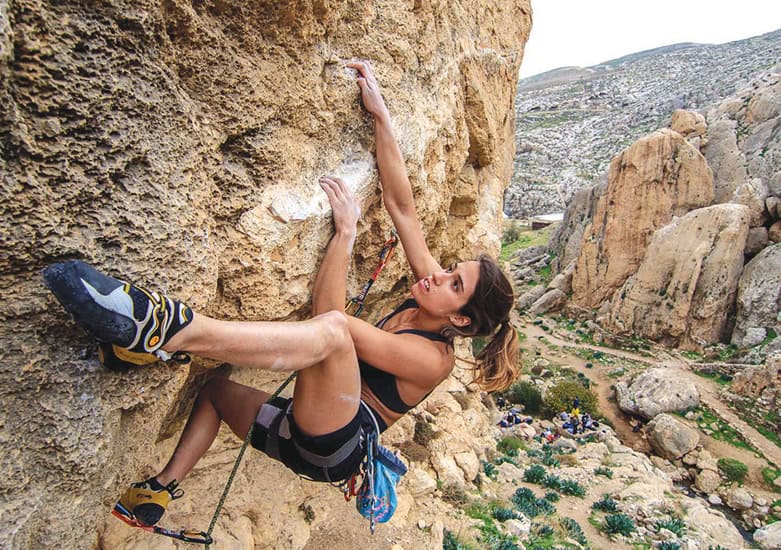
Adi Davis (right) and Yarden Roman at Nahal Rahaf (Photo: Alon Brookstein)
My niece Yarden, the daughter of my brother Jony, was taken hostage by Hamas from Kibbutz Be’eri to Gaza on Saturday, October 7, 2023. She was an avid rock climber from an early age, well known in the small community of Israeli rock־climbing adventurers. Together with the Israel Climbers’ Association, we have put together a photo gallery of some of the climbing adventures in Israel – waiting for the day she returns to climb again
Yadin Roman
From ERETZ magazine – issue no. 187 – December 2023
My niece, Yarden Roman־Gat, was kidnapped at Kibbutz Be’eri on Saturday morning, October 7, together with her three־year־old daughter Geffen and her husband Alon. They were bundled into a small car by four terrorists that sped towards the border fence with Gaza. Near the fence, the terrorists spotted an Israeli tank and stopped for a minute. With Geffen in her arms, Yarden and Alon, in a split־second decision, jumped out of the car and began to run up a small ravine. The terrorists fired after them with automatic weapons and gave chase. After running for about 200 yards, with bullets zipping around them, Yarden handed Geffen over to Alon and told him to run as quickly as he could. Yarden took off in a different direction and took refuge from the bullets behind a tree, directing the fire and the terrorists toward her.
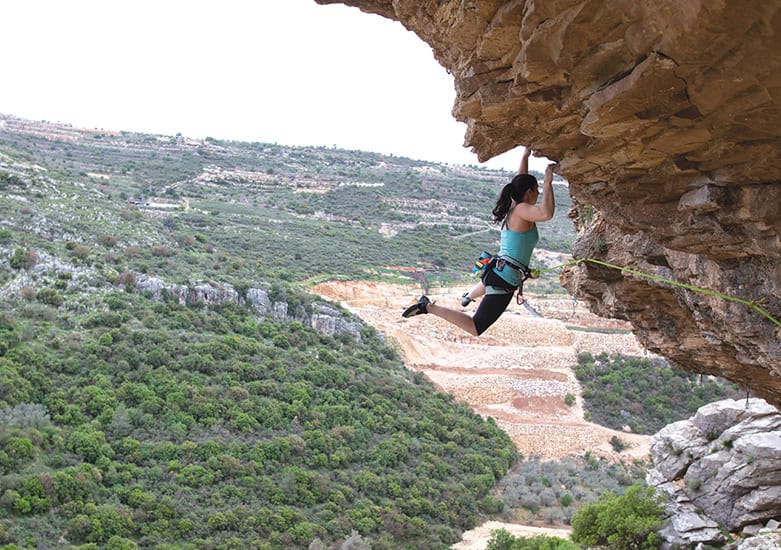
Inbal Katzenelson climbing Gita Cliff (Photo: Diego Rosman)
Alon, with Geffen, found a niche in the ground and scrambled into it, concealing their whereabouts with branches and bushes. For 12 hours, Alon and Geffen hid in their makeshift shelter with terrorists all around searching for them. The following day, Alon, with Geffen in his hands, made his way to the Kibbutz, where fighting between the terrorists and the army was still going on. Circumventing the Kibbutz, he reached the main road and the Israeli forces. The next day, Gili, Yarden’s brother, went to where she had last been seen. He scoured the area for four days with volunteers from the armed forces, including Bedouin trackers. No trace of Yarden was found. She had been retaken by her captors and taken to Gaza.
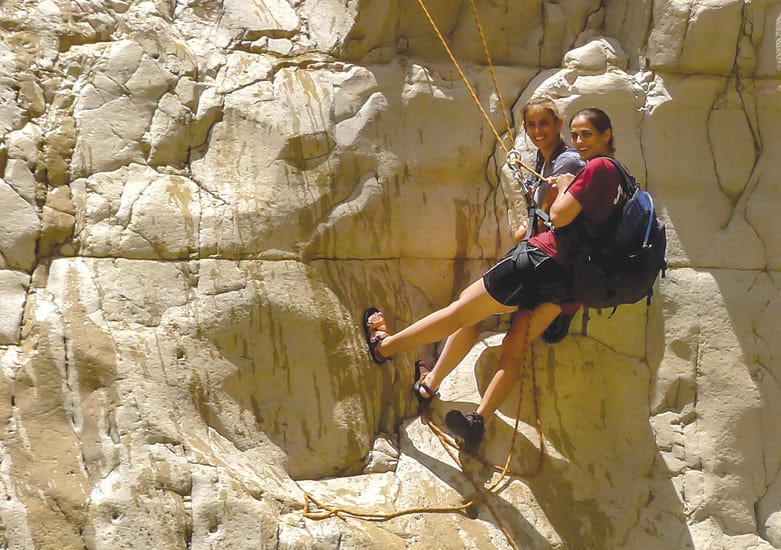
Yarden Roman (left) and Adi Davis (right) rappelling in Nahal Rahaf (Photo: Alon Brookstein)
Since she was a small child, Yarden loved the outdoors. Hiking and camping trips were her favorite pastime. Above all, she loved climbing. Rocks, cliffs, boulders, climbing walls, the lot. She was a member of her hometown climbing club, won a few trophies, and scaled many of the highest cliffs in the country. She met her future husband, Alon, at one of these climbing meets. Three months after they met, Yarden and Alon set out on a trip to the United States to reach some of the better־known sport־climbing sites. After Geffen was born, adventures had to be toned down a little, but the love for the sport remained. They planned to visit Australia and New Zealand to reach well-known rock climbing sites.
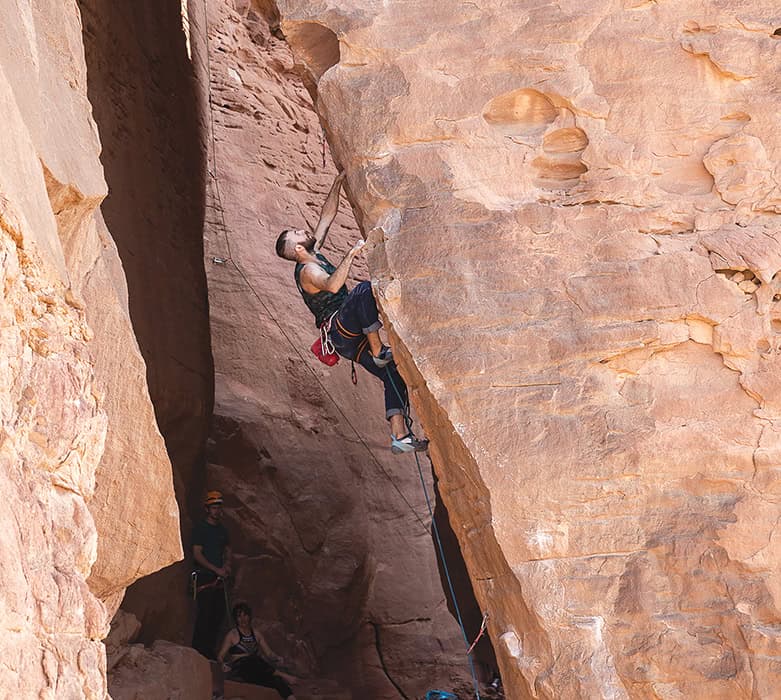
Valeri Kremer climbing the cliff in Ein Prat (Photo: Gilad Furst)
Rock climbing in Israel is a young sport. However, it is gaining in popularity. In 2019, the Israel Climbers’ Association was founded to serve the approximately 15,000 climbing enthusiasts in the country. Rotem Jacobs, one of the Association’s directors, knows Yarden well. Three decades ago, the small group of cliff lovers met repeatedly in competitions, events, and on the cliffs. “In a small country like Israel,” says Jacobs, “there aren’t many authorized climbing sites. The most challenging is at Ein Prat, in the Judean Desert. Others are at Beit Ariyeh, the Timna Park in the southern Arava Valley – where the management of the park is encouraging the development of this challenging sport – sites in the Judean Mountains, in the Ramim cliff overlooking Kiryat Shemona, in the Carmel and more. One of the tasks of the Association is to add more official climbing sites around Israel.”
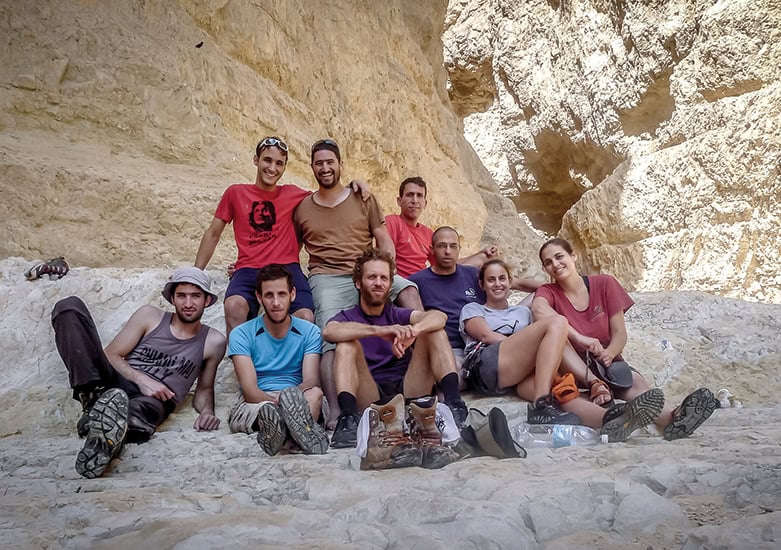
The climbing group in Kochav Yair hanging in Nahal Rahaf (Photo: Alon Brookstein)
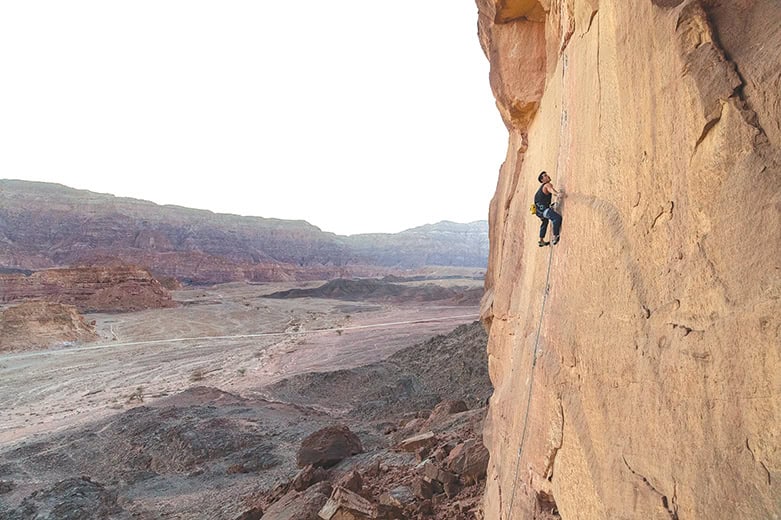
Timna Park is one of Israel’s most adventurous and challenging climbing sites. The Timna Valley is a horseshoe־shaped basin surrounded by high Nubian Sandstone cliffs in the southern Arava Valley. The Valley is famous for its many copper veins, one of the first places in the world where copper was mined. Archaeological excavations in the Valley have ascertained that copper mining activities started during the 5th and 6th millennia BCE and have continued throughout the ages. Dozens of copper mines and mining tunnels have been located in the Valley, with remnants of mining sites initially attributed to the Edomites and King Solomon (hence the sandstone pillars known as Solomon’s Pillars).
Mor Sapir climbing in Timna Park (Photo: Diego Rosman)
In Timna Park, over 85 climbing sites have been marked, 10־50meters high, encompassing all the different styles of sport climbing. The majority scale the smooth, straight sandstone cliffs; a few others scramble up single־standing boulders along the edges of the cliff face. Climbers from around Israel volunteered to help with this article, sending us information and photographs of climbing events. The Climbers’ Association is planning a climbing event, open to the public, in honor of Yarden and as part of the efforts to keep the struggle to release all the hostages foremost in the public eye.
Yosi Ben Yosef climbing in Timna Park (Photo: Diego Rosman)