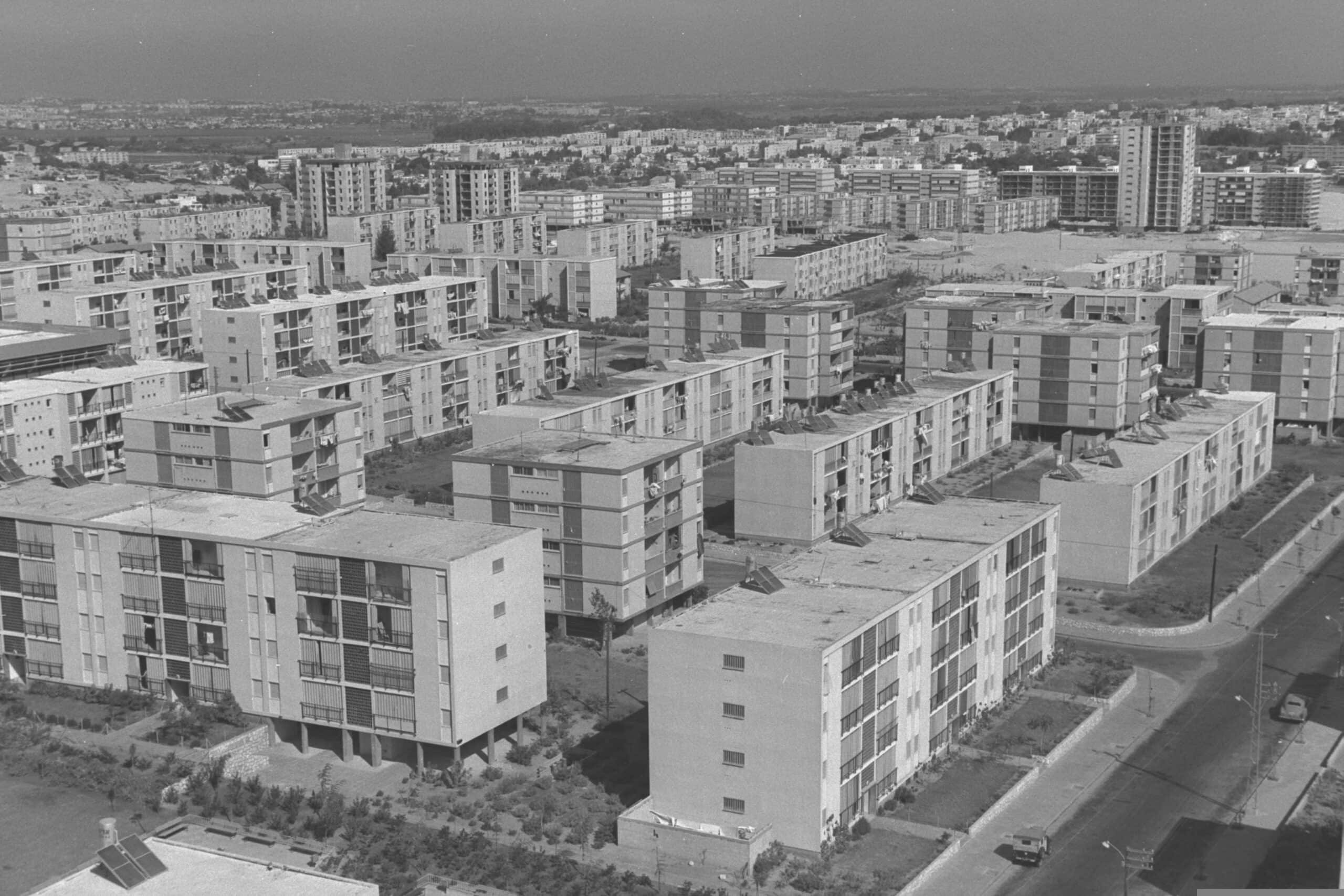
Bat Yam. round Two

Noa Borstein Hadad

Seven months ago, on the night of June 15, 2025, at 3 p.m., the floor of the small bomb shelter of my building on Daniel Street in Bat Yam trembled. The light went out at once.  A cloud of dust rose and filled the concrete-walled room. And then silence. Louder than the “boom” heard outside the building a moment earlier. The door of the shelter flew open, with a bang, from the blast that glued us all to the wall. Two passersby rushed in. “A missile has hit here, on the building!” they shouted and stormed out of the shelter. Even my first-floor neighbor’s loud transistor fell silent.

Emerging from the shelter, we blinked in disbelief at the extent of the destruction. The missile had hit the tallest building in our neighborhood – right in front of our building – the corner of Jerusalem Street and Daniel Street.

Thirty-five people are missing, news websites reported. Later that week, the final death toll of nine was announced.

The fleet of rescue vehicles, parked at the intersection of the two streets in the cordoned-off disaster area, encountered a parallel flood of civilians seeking to help or gather information about the situation. For our neighborhood, the building is a local landmark. The first “skyscraper” in the neighborhood, built with communal balconies, a kind of roofed area in the middle of the building, shared by all the neighbors. On the ground level is a commercial center that is almost as old as the entire neighborhood, with an ancient glazier who doesn’t intend to retire, a grocery store that imports nostalgic Russian food products, a store of cleaning products, and more.

“The scene has been declared a disaster area,” declared the news broadcaster. My neighbors, with dusty faces, walk aimlessly through the debris. Shards of glass, broken shutters, squashed vehicles, and unimaginable amounts of dust cover the road and sidewalk. A man empties a half-liter bottle of water on his car, impossibly trying to clear the dust.

A woman in a wheelchair is led by her daughter, who is holding a suitcase in her other hand. A half-torn Israeli flag flutters from a window with nothing left but a frame. In front of the “scene of the disaster,” a man and a woman sit on a bench, chain-smoking, staring at the building that, until a short time ago, was their home.

But all this was so long ago

On the morning of Saturday, February 28, 2026, when we, the residents of the small building on Daniel Street, met again in our shelter, the past was not foremost on our minds. The new neighbor’s dog, who had moved into the building after the explosion and the ensuing renovation, behaved like a Tasmanian Devil. One by one, she attacked all the dogs in the shelter. The 13-year-old boy holding her leash tried to calm her down. “Everything is fine,” he told her. The other dogs sniffed each other. The neighbor on the second floor, with his pet pincer, who was always dressed in the latest doggy style, handed out snacks for all. For the dogs, of course, not for us.

In the corner of the shelter, lit by the new light we had installed after the electricity was completely burned out in the previous round, sat the neighbor with the transistor. He turned the volume up, all the way, and a little more. Meaningless words from news broadcasters filled the air. The upstairs neighbor, with her two adult children, came down with folding chairs and set them up in front of the old bicycles leaning against the wall. Three months ago, regardless of anything, the House Committee (that’s me) decided to move an old sofa to the shelter – it’s better for us to have somewhere to sit instead of throwing it in the trash.

Subdued conversations in Russian, Arabic, and Hebrew resonate in the shelter. The words are absorbed into the white concrete walls. “Why did they start an attack in the winter?” one of the neighbors tries to start a conversation. “They usually attack in the summer,” says another neighbor. “It doesn’t matter if it’s winter or summer; there are elections soon,” another neighbor answers. “What a cynic you are,” the neighbor who started the conversation throws at her. It’s about the weather, politics, or both. The neighbor shrugs, and the conversation dies down.

“Well, what is being said?” someone asks. “Nothing yet,” reply those who managed to locate a wisp of Wi-Fi from their apartment.

The neighbor’s son from the first floor comes out of the shelter first. He’s a soldier, brave, and can’t remain in a closed shelter for long. After him, some of the others hesitantly leave. “They haven’t told us that we can get out yet!” declares another neighbor, as if taking on an official duty. However, he also leaves.  Closing the light behind him.

See you all with the next siren.  

Desert Respite

Noa Borstein Hadad

On Saturday, March 28, 2026, the siren sounded in Mitzpe Ramon. This was the only alarm since the start of the last campaign against Iran (as of writing). In the week since then, the city’s 6,000 residents have been joined by another 3,000 vacationers, who fled from the north and center to this desert town.

We arrived on Friday, March 6, in the morning. It was the day of our wedding, which should have taken place, but due to the “situation,” it was postponed – currently indefinitely. So, a friend offered us her holiday home in Mitzpe Ramon, in the Negev Highlands. We were looking forward to a quiet weekend. No sirens, no excitement, and all businesses closed. We planned a stay-in weekend and brought our own food.

Mitzpe Ramon is a unique kind of town. It was founded in 1954 as a road-building camp when the road through the Negev Highlands to Eilat was paved. Later, it became a mining town, then an exclusive experiment in communal living. However, it never actually succeeded until Israel evacuated the Sinai in 1982, following the peace agreement with Egypt. Following the evacuation, Mitzpe became a magnet for the off-road desert guides who had fallen in love with the wide-open spaces and mountains of the Sinai. The Negev is not the Sinai, and desert travel was complicated by the need to share the desert with military training areas. But Mitzpe developed a certain kind of off-road aura, a magnet for the just-returned-from-India crowd and seekers of an alternative lifestyle, alongside a Torah community of religious families. Perched on the cliff overlooking Makhtesh Ramon (The Ramon Crater), it developed its own unique, peaceful, mountain-desert character.

To our surprise, we arrived at a town in a blaze of action. Mitzpe was a non-stop party. On Friday morning, the Spice Routes neighborhood, named after the Nabatean Saudi Arabia-Mediterranean spice routes, a failed industrial park, turned into an ebullient social center. The streets of the neighborhood were filled with young people dancing to trance music—some with painted faces, and a bunch of barefoot kids running about. We watched as we waited for our iced coffee from one of the coffee shops next to a second-hand clothes store and a bakery, patiently waiting in the long coffee queue. No siren shattered the moment.


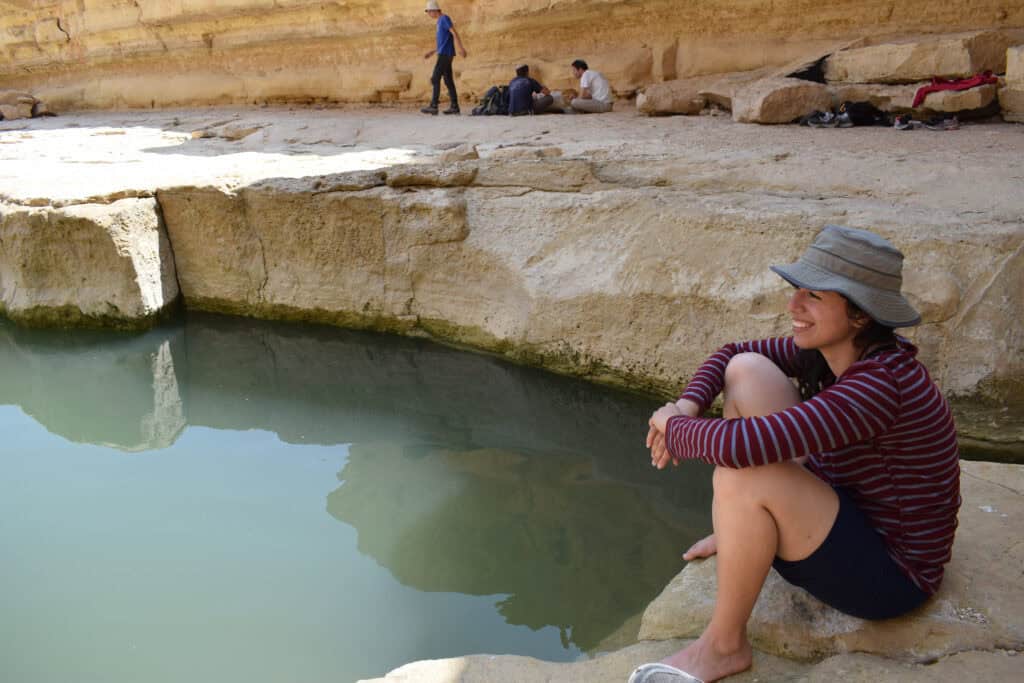
We continued on a trip to the Ein Yelek spring, actually a secluded pot hole that fills with water after rainy years. Around the spring, hidden in a little gulch, a group of young people was sitting around with beers and stories of the after-the-army trip that many of them had just returned from. Ayal, recently returned from a trek in South America, told us that the group had come together in the last few days in the local hostel. “We came here to get away from the war – to a place without sirens”. Each one of the young people, some just back in Israel, others just released from army service, had reached Mitzpe to find a few days of quiet.

“Sit next to us, and I will tell you a story,” says Ravit, a tall, tanned woman in her twenties, while another member of the group attempts to swim in the freezing spring. The group gathers around Ravit, while a sweet-smelling cigarette passes around. Ravit tells us about the beautiful beaches of Capurgana, Colombia, near the border with Panama, from where she had recently returned, straight into a war zone.

The brave guy trying the frozen waters of the spring lets out a shrill scream and exits quickly. The magic story moment of beautiful, faraway beaches is broken, and we pack up, trying to get back to Mitzpe before sunset. Ayal asks for a lift. Along the way, he tells us about his latest Euro-trip, still amazed by open borders and wide spaces, and by countries where security and safety are not fragile.

Camel Hill

Saturday morning, a week into the war, we make our way to Camel Hill, a local observatory overlooking the Maktesh, on a camel-shaped rock on the cliff edge. Religious families on their way to the synagogue dot the empty streets. On the hill, several families with children join us. We share our binoculars with the children for a closer view of the Negev Highlands. In such a small country, at the height of a war, it is difficult to believe that such a peaceful place exists.
At this very moment, our cell phones start vibrating with missile warnings. But nothing breaks the silence. Mitzpe is not on anyone’s map.

Two hours later, I am seated on the porch of my friend’s vacation home. The desert winds carry the sounds of another party and the smells of a barbecue. On the other side of the road, in a construction lot with three unfinished houses, a lively Purim party is in full swing. “This is the meaning of life, dancing between the sirens,” one of the party-goers explains.

That evening at the local “Berekh” pub, a full-scale party is revving up– even though Home Front security regulations currently forbid gatherings of more than fifty people. The police arrived and decided to allow it, despite the regulations, which seem not applicable in Mitzpe. Michal, the waitress, who has been living in Mitzpe for the past two years while saving for circus studies, explains that parties at the pub are a nightly occurrence. “The only difference,” she adds, while clearing our table, “is that this week I don’t know everybody around the table.”

The pub, the only one in the Spice Routes neighborhood, is full. We try to find a place at the bar and settle for a table for two with Gal and Gilad, a young couple from Tel Aviv. Gal used to live in Mitzpe before moving to Tel Aviv. However, with the first siren, she moved back. Gilad joined her.

Gal, a doula by profession, had to return to Tel Aviv to assist a client giving birth. At the height of labor, the mother and the team had to make their way to the hospital shelter. She quickly returned to Mitzpe, to the clean desert air. “We are here without a deadline,” she says. “We will go back when it is safe again.”


Development Town

Mordechai was born and raised in Mitzpe. He is 18 and about to enlist in the Givati Brigade at the end of the month. He is currently hanging out at the pub with his friends. “Mitzpe is a fun place,” he says, “but the only time the town fills up is during a war.”

Actually, there is no place to hang out except the pub. “Why is this the only pub?” we ask. “There are not enough clients to go around for two,” he explains, “and another pub would only start a local war.”

In the last few years, a local war has indeed been fought in Mitzpe, between the religious and secular communities. “The growing religious community, which began settling in Mitzpe a decade ago, landed on a very secular, hippie-like community”, explains Mordechai. “Each community wants the town to have their characteristics – closed or open on the Sabbath, more synagogues instead of secular community centers, and more. Government ministries back the religious communities, and the secular population feels like they are fighting a losing battle. The two communities will have to live with each other,” explains Mordechai, “War is not appropriate for our beloved town”.

Mordechai gets up to dance in the interior room of the pub. The local community meets the Tel Aviv yuppies for a trance party in the desert. We join in and dance until the first light of the morning.

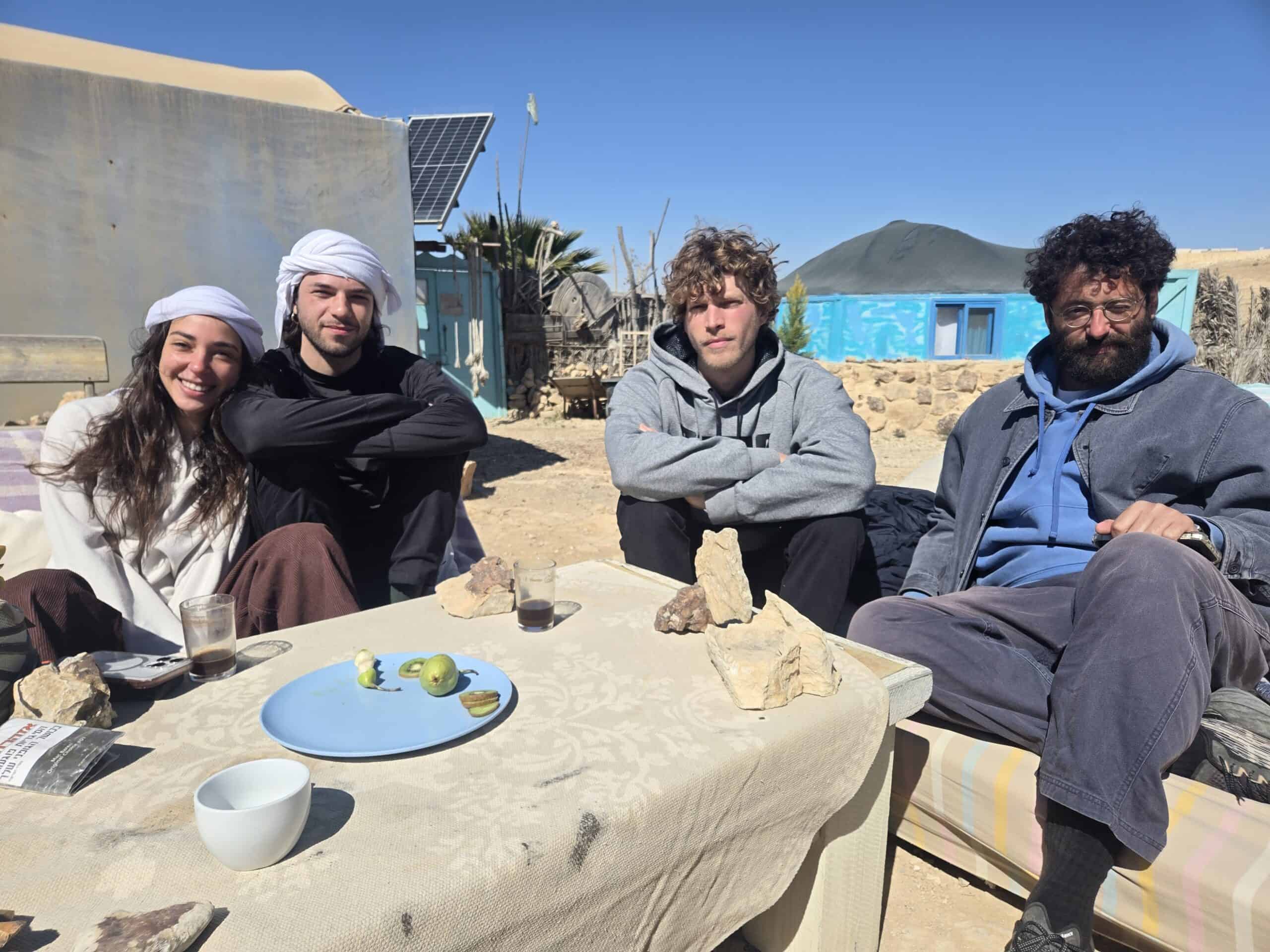
We start the next morning late, very late. The place feels like a vacation, and everyone here is a late starter. Passing through the ecotourism area, we find a local hostel. Cabins with no electricity, public outdoor showers, and a circle of old sofas open to the wind and sun. We meet Taliya Lin Ron, Yarden Tiger, and Nadav Tom Artshik, who made their way to Mitzpe with the first siren. The three are actors who met a film director, Pinhas Viya, in the hostel. They are now considering continuing south, to Eilat or the Sinai.

“We have been here for a week”, explains Taliya, “and it seems that we have had enough of the extreme quiet”—the discussion centers on films and advice on things to do. Very soon, the conversation turns to the events of October 7; for many of this generation, this is the moment that marks the start of their lives.

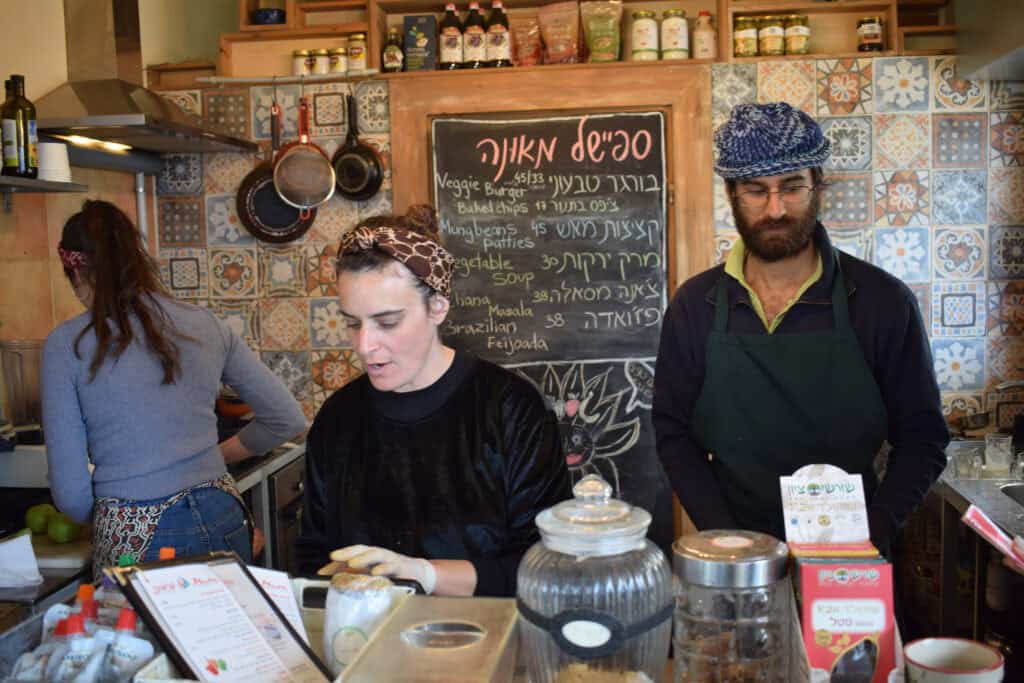
In the Spice Routes neighborhood, business goes on as usual. The streets are full, and the line for coffee is long. Standing in line at the local pastry shop, we listen to the omgoing conversation. “There was a missile strike in North Tel Aviv”, one woman tells her friend, “someone was hit, badly”. “We have asked to extend our stay here,” the friend adds, “but there is no available place. People are knocking on doors asking if there is a place to stay, with full payment.”

“Mitzpe is a good place for your Chapter Two,” A man in the line adds. “I wonder what Tinder offers here”.
Black desert humour. Starting a new life in the desert. Maybe this will finally bring life to the small desert town perched on its cliff, where the only thing to do is trekking in the desert, enjoying the tranquility.
Noa Borstein Hadad

Siren Culture

Noa Borstein Hadad

Sirens again, dashing for the shelter. The previous war, nine months ago, caught us off guard, unsheltered. In general, neighborhood shelters are best avoided. They are dirty, damp, smelly, dark, and unsuitable for long-term occupancy. We vowed never to be caught that way again.

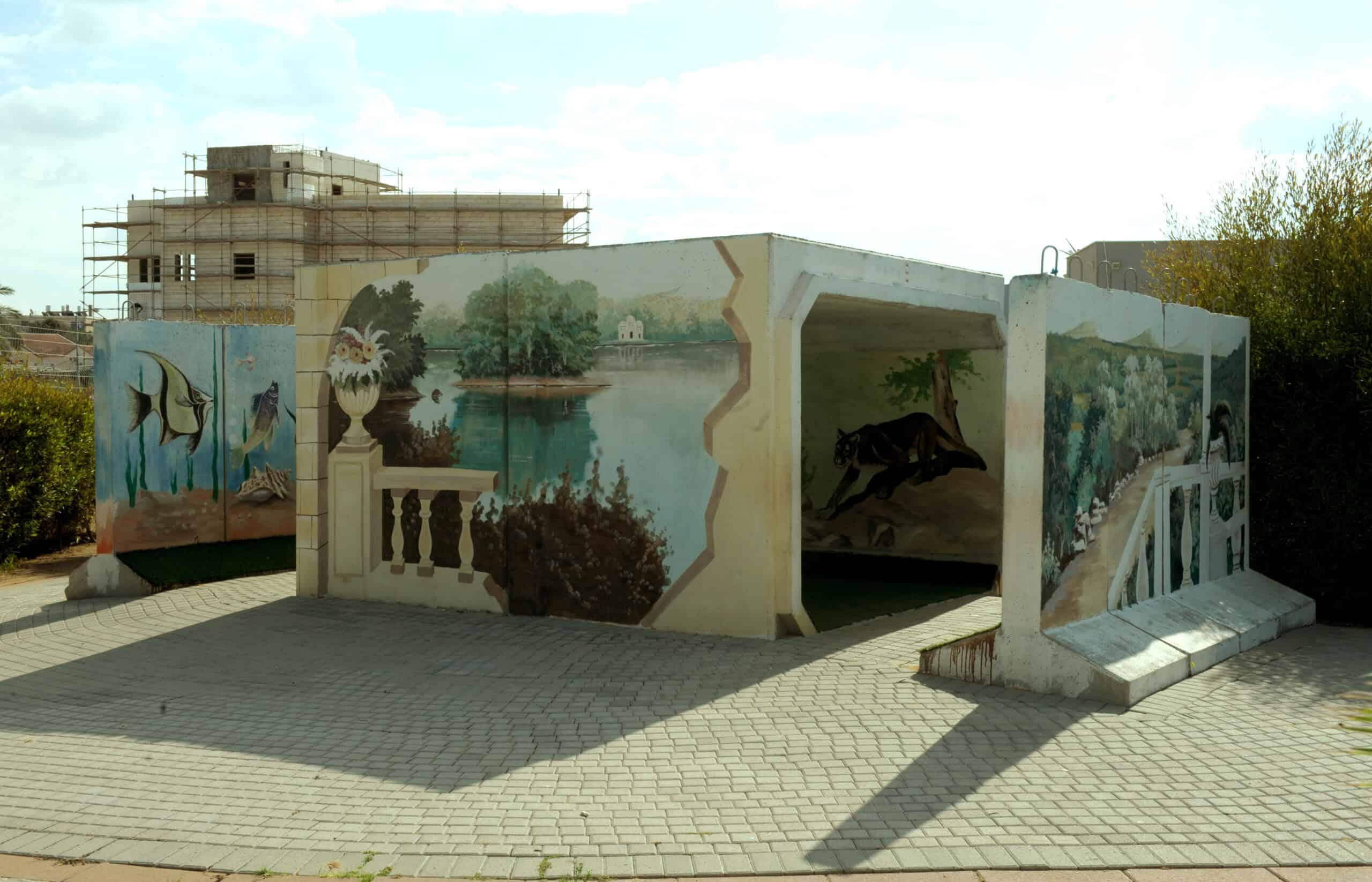
This time, we were ready. The lights in the shelter were fixed and working, and redundant sofas and chairs had been dragged in to make the stay more comfortable. One of the neighbors added a chest of old games from her storage room. The house committee brought an electrician ahead of time to add outlets for charging cell phones or for a heater or cooler. Beach chairs were neatly folded in the corner, and the non-standard wooden window was attached to the wall with large screws. No Iranian missile will be able to dislodge it.

With these improved conditions, the current battle with Iran feels different. On the one hand, screaming sirens still cut through our fractured lives. On the other hand, we have ceased to run hysterically to the shelter every time they go off. We stride confidently to the shelter nearest our building, or to our safe rooms, exercising our lives in the unique Israeli oxymoron called a state of Regular Emergency.

The Tel Aviv area is among the most targeted by missiles in the current confrontation. The resilient Tel Avivis, instead of waking up the kids and running for shelter four times a night, for a quarter of an hour each time, have found other ways to make the state of regular emergency easier. For example, setting up camp in the large public shelters constructed by the municipality, or the large underground parking lots, or the underground stations of Tel Aviv’s light rail. Car parks and train stations have been transformed into colorful, lively, and bustling depots.

Tel Aviv

At the Dizengoff Center parking lot, dance and yoga lessons were offered, offering peace of mind for body and soul. Very quickly, a local what’s-up community sprang to life with invitations for Shabbat services, free catering, and after-missile parties.

Throughout Tel Aviv, the social network buzzed with shelter ratings. “Nice local atmosphere and hospitality,” reported one Instagram follow-up; another mentioned “unpleasant smells” or “seating and water coolers” give me a like and recommend to a friend. A new wave of followers has been invented.

Other influencers gained their likes by inspection tours of public shelters. “Located 50 meters from the street”, ran one report. “During our visit, the shelter was clean, organized, and cool,” wrote another self-appointed shelter rater after a missile-break inspection of a shelter in the posh Bavli neighborhood in North Tel Aviv. “However, the shelter is small, especially for families with kids.” Join my followers for more reports.

“Warm and safe” was the rating for a shelter near Dizengoff Circle. “A very cute shelter. Not underground, but clean. I visited it during the 11 o’clock siren, and it was very crowded,” wrote Daniel this morning, rating a shelter in a South Tel Aviv neighborhood.

“This is a really hot shelter,” reported someone about a shelter in the cool Florentin neighborhood, “it doesn’t have an air conditioner.” Florentin excels at the highest number of shelter ratings, offering the most creative reviews. “Crowded during happy hour, empty during off-season. 100% protection with concrete vibes and a slight crowd,” reported a bar aficionado. A more poetic influencer notified his following that his local shelter had “Morgue lighting, Blender acoustics, and an Intoxicating smell of rats and cats (thanks to Mitzi the cat), no wifi, no air, but indie performances, and a pack of cute dogs. Bring wine, something to sit on, and something to nibble.” We will join with the next siren, answered one of the likes.

“Let me tell you of a secret shelter that everyone in Tel Aviv wants to know where it is,” wrote Tomer after the last attack. “Excellent location for meditation – a 20-minute detachment from the noise and tempo of the outside world – no wifi connection. There is also a VIP room with a little ventilation. I will return – if a missile doesn’t get me first”.

Meanwhile, on TikTok, the “Rate My Bomb-Shelter” trend is exploding. While making their way to the shelter, more and more people are sending photos and videos of their neighborhood haven, highlighting the latest additions and accoutrements, and asking to leave a rating for the shelter.

“After consulting with all the neighbors, I have decided to give our shelter a low rating”, explains a resident of the Kiryat Shalom neighborhood, “to avoid overcrowding,” he says with a smile. “There is a lot of space, but not enough chairs”. However, the attempt failed, and the shelter currently has a five-star rating.

The above-mentioned shelter, like many neighborhood shelters, is a microcosm of the political tendencies, beliefs, and arguments characteristic of Israeli society in recent years. The shelter has two parts: the right side, normally used as a synagogue, and the left side, used as a youth club. “In the beginning, everyone sat together, in the order of arrival. However, over time, the shelter divided”, reports a resident of the neighborhood, “the religious people who arrive without cellphones sit on the synagogue side of the shelter. They don’t adhere to the all-clear signal on the cell phone, but leave when they feel safe and protected. The secular residents sit on the youth club side of the shelter, which has wifi reception, and wait for the instructions from Home Command.”

The residents of this diverse neighborhood don’t argue about politics. They are divided over the door policy – or in more exact terms, when to close the shelter’s massive steel door. “The minute an early missile attack notice is sent, people begin to make their way to the shelter, in order not to be bottlenecked at the entrance when the siren sounds”, explains a resident. “The people who are already in the shelter want the door to be shut immediately. Others, at the bottleneck at the entrance, and others curious to watch the interceptors whooshing to the sky, stand outside and prefer to lock the door a few minutes after the siren. It is a heated argument with raised voices and fear”.

 With all this new cultural shelter vibe, it is important to remember that thousands of people have been killed or wounded in the current conflict. Currently, in Israel, 11 people have been killed due to missile attacks and another 3,000 wounded. It seems the missile vibe is actually about alleviating the “Russian Roulette” fear of living under constant missile attacks.

Beacon on a Hill

Yadin Roman

In 1630, John Winthrop delivered the famous “City on a Hill” Sermon to the settlers about to set sail for New England. The Biblical quote “A city that is set on a hill cannot be hid” comes from Matthew 5:14 and was spoken by Jesus during the Sermon on the Mount. The city on the hill referred to in the Sermon was probably Susita, the city perched on a hill overlooking the Sea of Galilee and clearly visible from the surrounding area. John Winthrop and many American presidents have used this phrase to describe a country that spreads goodness to the world.

The same idea was at the base of the founding of the State of Israel. Herzl, Jabotinsky, Haim Weitzman, the philosopher Martin Buber, Albert Einstein, and many others envisioned the Jewish State as a center for spreading development and learning throughout the region and the world. My mother believed in it when she founded the Technical Assistance Department in the Ministry of Agriculture, bent on sending Israeli farmers to third world countries to teach modern agricultural methods – and my father believed in it, in a visionary letter to my mother in 1956 – that one day Israel will be at peace with its neighbors, a technical and economic hub in the Middle East.

Somewhere along the road, all these utopian ideas were derailed. It is easiest to blame it on the Arabs who did not agree to the creation of Israel, but, seventy-seven years later, sitting in my safe room with missiles raining down and interceptors whooshing up, it got me thinking as to why this is happening.  

Over the years there have been many wars that we have won. But, only for a brief period in the 1980s, peace was in the air – a vibe quickly killed by extremists on both sides.

Missiles and bombs have become a way of life in the last two decades, with massive arsenals on both sides. We are constantly living in an oxymoronic status defined as “regular emergency”, which is gradually developing a unique culture of its own.

These next few articles are about the new “regular emergency” Israeli culture – a small psychological release from the pressure we are living in, remembering that there are many casualties from these attacks. People have been killed, wounded, and traumatized.

“The time has come, the Walrus said, to talk of many things.” Tweedledum and Tweedledee sang to Alice in Wonderland about The Carpenter and the Walrus, and indeed it seems that the time has come to rethink a lot of things, before, like the oysters in the poem, we will all be eaten up.